About the Institute
  • English

Breadcrumb

  1. Home
  2. Microbiota 25 - October 2026
  3. Why do different people behave differently to probiotics?
  • Our publications
    • News
    • HCP Magazine
    • Thematic pages
    • Thematic folders
    • Overviews - Microbiota Magazine
  • About the Institute
    • About us
    • International Microbiota Observatory
    • Press room
    • Partnerships
  • Congresses
    • Congress calendar
    • Congress reviews
  • Continuing Medical Education
    • Accrediting courses
  • Useful documents
    • How to talk about
    • Infographics
    • Diagnosis tools
    • Patients Stories
    • Experts' point of view

Lay public section

Find here your dedicated section
Gastroenterology
Gynecology
Pediatrics
General Medicine

Breadcrumb

  1. Home
  2. Microbiota 25 - October 2026
  3. Why do different people behave differently to probiotics?

Why do different people behave differently to probiotics?

. Sourav Goswami 

. Alisha Ansari 

. Dr. Tarini Shankar Ghosh 

Indraprastha Institute of Information Technology Delhi, India

Sourav Goswami and Alisha Ansari are joint first authors and PhD scholars working in the Microbiome Informatics Lab, headed by Dr. Tarini Shankar Ghosh, in the Department of Computational Biology at the Indraprastha Institute of Information Technology (IIIT-Delhi), India. Their work focuses on large-scale, multi-cohort microbiome analysis, probiotic science, and building data-driven tools that translate population-level patterns into personalized predictions.

Gastroenterology
Gynecology
Pediatrics
General Medicine
  • Our publications
    • News
    • HCP Magazine
    • Thematic pages
    • Thematic folders
    • Overviews - Microbiota Magazine
  • About the Institute
    • About us
    • International Microbiota Observatory
    • Press room
    • Partnerships
  • Congresses
    • Congress calendar
    • Congress reviews
  • Continuing Medical Education
    • Accrediting courses
  • Useful documents
    • How to talk about
    • Infographics
    • Diagnosis tools
    • Patients Stories
    • Experts' point of view

Lay public section

Find here your dedicated section

Sources

This article is based on scientific information

Sharing is caring

Your colleagues might be interested in this topic. Why not share it?

  • Facebook
  • Twitter
  • LinkedIn
  • Mail

Sections

Congress review 2026

About this article

Created 09 November 2026
Updated 09 November 2026

When probiotics meet the gut microbiome

Walk into any pharmacy and you will find an entire shelf devoted to probiotics. Among the most common are Bifidobacterium species, marketed for gut health, immune support, healthy aging, and an expanding range of clinical conditions. Yet probiotic benefits sharply differ among individuals. Clinical trials consistently show that while some people experience clear and lasting improvements, others derive little or no benefit.

One reason could be the persistence of the probiotic in the individual's gut, which could be influenced by the gut microbiome that already exists before a probiotic is consumed. Think of it like a new tenant moving into a crowded building: the incoming bacterium has to compete for resources and find its place among microbes that were already there. Its ability to colonize and persist depends not just on its own traits but on the resident community it walks into.

Previous studies had implicated baseline microbiome composition in probiotic engraftment, but they were limited to small cohorts and individual strains, leaving open whether microbiome features can reliably predict probiotic success. In this study, we address this question through the largest global meta-analysis of its kind, identifying the microbial features that shape Bifidobacterium colonization and introducing a framework to predict an individual's receptiveness to probiotic treatment¹.

Bifidobacteria keep selective company

Investigating 51,244 gut microbiomes (from 149 study-cohorts across 45 countries), we observed consistent sets of bacteria being associated with specific Bifidobacterium. Butyrate producers and members of the genus Collinsella tended to show consistent positive links with certain Bifidobacteria, while certain pathobiont Firmicutes and Bacteroidota behaved negatively. We captured these patterns as Association-Scores, a measure of how reliably a microbe accompanies a given Bifidobacterium.

These scores were stable: when recalculated across different diseases and compared against apparently non-diseased individuals, the associations largely held, and the same was true after adjusting for host properties like diet, medication, clinical factors, and also for certain microbiome properties. Bacteria "helping" Bifidobacterium in healthy guts tended to do so in sick ones too, which points to a real microbial relationship rather than side effects of illness itself. Mapping only the associations that passed all checks revealed a compact, consistent pattern: Collinsella and a handful of oral, Bacteroidetes, and Firmicutes groups linked reliably to specific bifidobacteria, no matter which lens was used to look for them¹.

Image
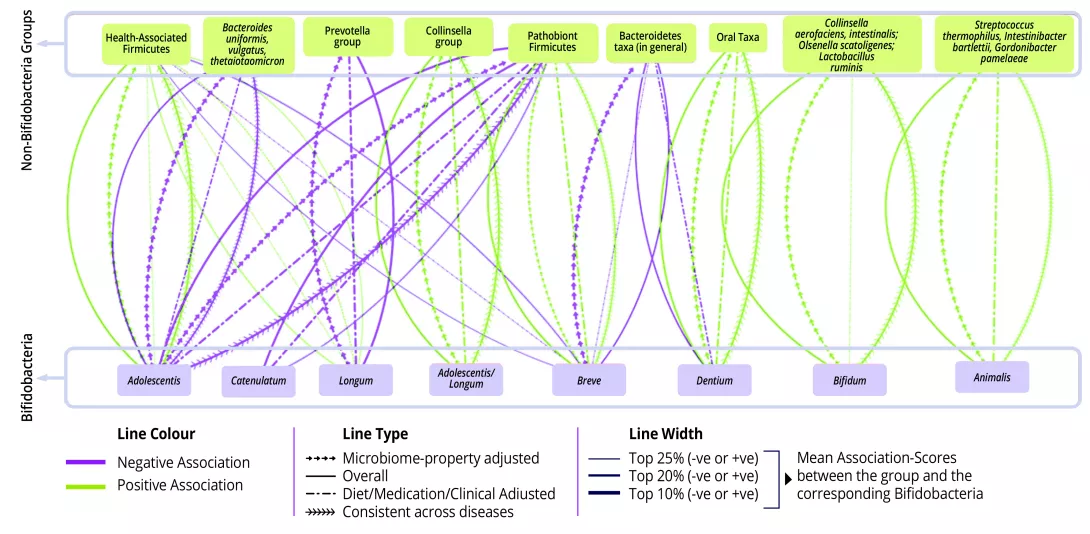
Figure 1 FOCUS

The Receptive-Score

We then asked whether these patterns could predict something practical: whether a probiotic actually persists after someone takes it? We developed the Receptive-Score, which measures how welcoming a baseline microbiome is to a specific Bifidobacterium using its known microbial associates and baseline abundance.

Investigating eight independent probiotic trials, the Receptive-Score combined with baseline Bifidobacterium levels correctly predicted post-treatment persistence or increase in 69.23% of trial-probiotic combinations. In a B. longum trial², people who became persisters had significantly higher baseline Receptive-Scores than non-persisters. In two trials³,⁴ with clinical follow-up, higher scores also lined up with better clinical outcomes, including fewer gastrointestinal symptoms and lower inflammation markers, though sample sizes were too small for firm conclusions there.

What the genes reveal

To understand what might drive these relationships, we examined the genomes of 66 non-Bifidobacterium taxa. We identified specific genes and metabolic pathways in bacteria that showed strong positive associations with the health-associated B. adolescentis and B. longum, revealing a cooperative cross-feeding network. Many of these bacteria encoded enzymes involved in the breakdown of complex dietary carbohydrates and the production of metabolites such as acetate that can be exchanged within the microbial community, creating a nutrient-rich environment that supports Bifidobacterium persistence.

In contrast, bacteria associated with B. breve and B. dentium were enriched for genes involved in metal ion acquisition and scavenging, suggesting adaptation to resource competition and inflammatory conditions rather than metabolic cooperation. These findings indicate that the ability of different Bifidobacterium species to colonize in the gut may depend not only on their own biology but also on the metabolic capabilities of their microbial neighbours.

Predicting how your gut microbes will change

While the study still has certain gaps (limited representation of non-industrialized populations, species-level investigations while probiotics are typically characterized at strain level, limited data on clinical outcomes), this framework of capturing the receptivity of a microbiome to a given microbe can be generalized to build "digital twin" models of a person's gut community that let scientists test probiotics, dietary changes, or other microbial therapies in silico before ever trying them on an actual patient

Key points

  • A gut's existing bacteria shape whether a Bifidobacterium probiotic will persist.
  • Receptive-Scores predicted persistence in 69.23% of trial-probiotic pairs tested.
  • Analysis of functional signature linked to these association patterns identifies cross-feeding as a likely mechanism.

Conclusion

This work shows that a person's existing gut bacteria actively gatekeep whether a probiotic takes hold. Reading that baseline community may one day help clinicians choose the right Bifidobacterial strain for the right person, rather than relying on trial and error.

Sources:

1. Goswami S, Ansari A, Sharaf C, et al. Gut microbiome features associated with Bifidobacterium colonization predict personalized probiotic persistence patterns. Nat Commun 2026; 17: 5678.

2. Maldonado-Gómez MX, Martínez I, Bottacini F, et al. Stable Engraftment of Bifidobacterium longum AH1206 in the Human Gut Depends on Individualized Features of the Resident Microbiome. Cell Host Microbe 2016; 20: 515–26.

3. Ramakrishnan M, Cross TL, Organski AC, et al. Two-week supplementation of Bifidobacterium adolescentis iVS-1 reduces symptoms associated with lactose intolerance in lactose maldigesters. Gut Microbes Rep 2025; 2: 2508199.

4. Ba Z, Lee Y, Meng H, et al. Matrix Effects on the Delivery Efficacy of Bifidobacterium animalis subsp. lactis BB-12 on Fecal Microbiota, Gut Transit Time, and Short-Chain Fatty Acids in Healthy Young Adults. mSphere 2021; 6(4): e0008421.

Tags
Microbiome Flora
    Focus
    Microbiota 25 - October 2026
    • Overview
      • Functional dyspepsia and the gut microbiota
    • Commented article
      • Gut micro-organisms associated with health, nutrition and dietary interventions
      • Antenatal depressive symptoms impair offspring neurodevelopment by inducing maternal gut microbiota dysbiosis during pregnancy
    • Congress review
      • Highlights from the ESPGHAN 2026
    • Focus on Young researchers
      • Why do different people behave differently to probiotics?
    • Press review
      • Gut microbiota #25
      • Vaginal microbiota #25
    • Expert opinion
      • Millets as powerful prebiotics
    Created 09 November 2026
    Updated 09 November 2026

    About this article

    To know more about this topic.

    Content type

    Congress review
    Highlights from the ESPGHAN 2026
    Gut microbiota #25
    Focus

    Microbiota 25 - October 2026

    Overview

    Functional dyspepsia and the gut microbiota

    Commented article

    Gut micro-organisms associated with health, nutrition and dietary interventions Antenatal depressive symptoms impair offspring neurodevelopment by inducing maternal gut microbiota dysbiosis during pregnancy

    Congress review

    Highlights from the ESPGHAN 2026

    Focus on Young researchers

    Why do different people behave differently to probiotics?

    Press review

    Gut microbiota #25 Vaginal microbiota #25

    Expert opinion

    Millets as powerful prebiotics
    • Our publications
      • News
      • HCP Magazine
      • Thematic pages
      • Thematic folders
      • Overviews - Microbiota Magazine
    • About the Institute
      • About us
      • International Microbiota Observatory
      • Press room
      • Partnerships
    • Congresses
      • Congress calendar
      • Congress reviews
    • Continuing Medical Education
      • Accrediting courses
    • Useful documents
      • How to talk about
      • Infographics
      • Diagnosis tools
      • Patients Stories
      • Experts' point of view

    Lay public section

    Find here your dedicated section
    Gastroenterology
    Gynecology
    Pediatrics
    General Medicine
    • English

    Browse the site

    • Our publications
      • News
      • HCP Magazine
      • Thematic pages
      • Thematic folders
      • Overviews - Microbiota Magazine
    • About the Institute
      • About us
      • International Microbiota Observatory
      • Press room
      • Partnerships
    • Congresses
      • Congress calendar
      • Congress reviews
    • Continuing Medical Education
      • Accrediting courses
    • Useful documents
      • How to talk about
      • Infographics
      • Diagnosis tools
      • Patients Stories
      • Experts' point of view

    Lay public section

    Find here your dedicated section

    Discover

    Gastroenterology
    Gynecology
    Pediatrics
    General Medicine

    Join the microbiota community

    • Facebook
    • Twitter
    • LinkedIn
    • YouTube
    • Instagram
    • Bluesky

    Lay public section

    Find here your dedicated section

    Redirection

    You are about to be redirected and leave our website

    • Be redirected
    • Stay on the Biocodex Microbiota Institute's website

    Stay updated

    Join the Microbiota Community of HCPs and researchers and receive “Microbiota Digest” and "HCP Magazine" to stay up to date on the latest news about microbiota.

    * Mandatory Fields

    BMI 20-35

    Stay with us !

    Join the Microbiota Community of HCPs and researchers and receive “Microbiota Digest” and "HCP Magazine" to stay up to date on the latest news about microbiota.

    * Mandatory Fields

    BMI 20-35

    Explore

    Expert opinion 25
    09.11.2026

    Millets as powerful prebiotics

    Read the article
    Vaginal microbiota 25
    09.11.2026

    Vaginal microbiota #25

    Read the article
    Couv press review Mag 18
    09.11.2026

    Gut microbiota #25

    Read the article
    • Our publications
      • News
      • HCP Magazine
      • Thematic pages
      • Thematic folders
      • Overviews - Microbiota Magazine
    • About the Institute
      • About us
      • International Microbiota Observatory
      • Press room
      • Partnerships
    • Congresses
      • Congress calendar
      • Congress reviews
    • Continuing Medical Education
      • Accrediting courses
    • Useful documents
      • How to talk about
      • Infographics
      • Diagnosis tools
      • Patients Stories
      • Experts' point of view

    Lay public section

    Find here your dedicated section

    Discover

    Gastroenterology
    Gynecology
    Pediatrics
    General Medicine

    Lay public section

    Find here your dedicated section

    Join the microbiota community

    • Facebook
    • Twitter
    • LinkedIn
    • YouTube
    • Instagram
    • Bluesky

    © 2026 Biocodex. All rights reserved.

    • Legal notice
    • GTU
    • Data protection policy
    • Sitemap
    • Cookies settings
    • Digital accessibility : partially compliant
    Biocodex logo