

Gut micro-organisms associated with health, nutrition and dietary interventions
COMMENTED ARTICLE - Adult’ section
By Prof. Harry Sokol Gastroenterology and Nutrition Department, Saint-Antoine Hospital, Paris, France
Comments on the article by Asnicar et al. Nature 2026¹
Lay public section
Find here your dedicated section

About this article
Created
09 November 2026
Updated
09 November 2026
The incidence of cardiometabolic diseases is increasing globally, with both poor diet and the human gut microbiome implicated. However, large-scale comprehensive studies exploring these links in diverse populations are lacking in this area. Using data from over 34,000 participants in the US and the UK, this study highlights significant associations between diet, the gut microbiome and cardiometabolic health markers. The authors have established “ZOE Microbiome Health Ranking 2025” to rank the species most and least favourably associated with human health markers, validated in over 7,800 independent samples. In dietary interventional clinical trials (746 participants), favourable species increased while unfavourable species decreased. These findings strengthen the link between diet, the microbiome and health, whilst emphasising that prospective and interventional studies are still needed to establish a causal link.
What do we already know about this subject?
Cardiometabolic diseases, particularly cardiovascular disease and type 2 diabetes, are the leading cause of morbidity and mortality in Western countries². Whilst diet is the main modifiable risk factor, the gut microbiome is now recognised as playing a key role in metabolism, due to its influence on diet and involvement in obesity, as well as insulin resistance and inflammation. However, studies available up to now have been based mainly on small and lowly diversified cohorts, with limited microbiological and phenotypic data³⁻⁵, which has hindered the identification of robust and universal microbial biomarkers and definition of a “healthy microbiome” applicable at a population level.
What are the main insights from this study?
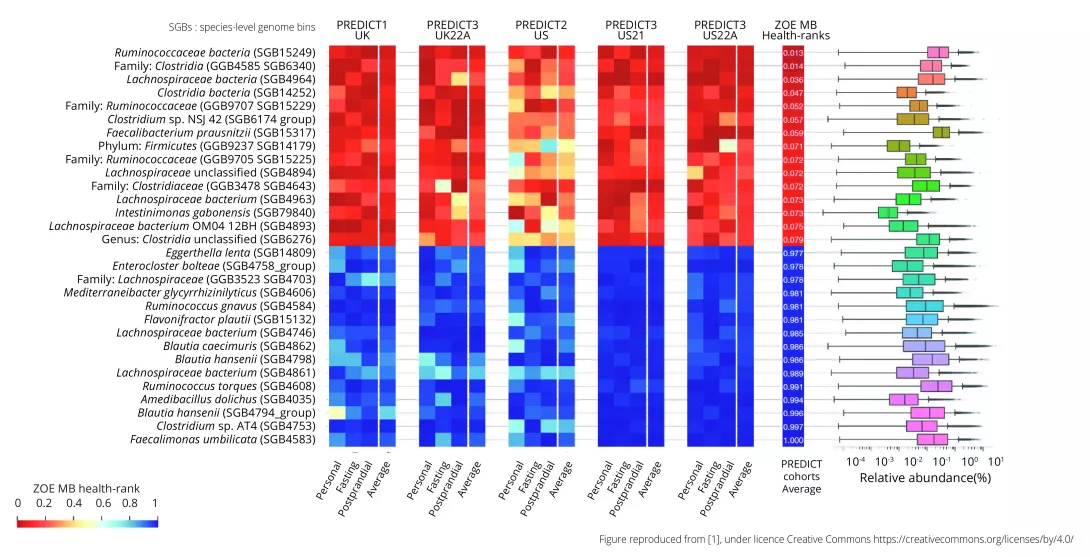
To answer these questions, the authors pooled and harmonised five metagenomic cohorts (United States and United Kingdom), representing a total of 34,694 participants with high-depth shotgun metagenomic sequencing, validated diet questionnaires, and a complete panel of cardiometabolic markers. Using machine-learning models trained on the relative abundance of 661 microbial species (defined as species-level genome bins, or SGBs), the authors showed that the microbiome reproducibly, albeit moderately, predicts numerous cardiometabolic health markers [AUC 0.64–0.73 for classification; Spearman’s correlation coefficient 0.30–0.46 for regression analysis (figure 1)].
These findings led to the creation of “ZOE Microbiome Health Ranking 2025”, a ranking system for 661 species based on their clear link to host health markers (personal health, fasting markers, postprandial markers) and diet quality. The highest-ranked species (close to 0), which are associated with a favourable metabolic profile, belong mainly to the phylum Firmicutes and Clostridia and Ruminococcaceae classes, but most are uncharacterised. Of the top 50 species, 22 were unknown organisms represented solely by genomes reconstructed from metagenomic data. Among the known species, Faecalibacterium prausnitzii and Eubacterium siraeum are classified in the most favourable category, a finding consistent with the literature. Conversely, the lowest-ranked species (close to 1), which are associated with an unfavourable profile, include organisms already known for their harmful effects such as Ruminococcus gnavus, Ruminococcus torques, Flavonifractor plautii, Enterocloster bolteae and Eggerthella lenta.
The authors then validated this classification using over 7,800 independent public samples. On average, obese individuals had 1.95 more unfavourable species than normal-weight individuals, and 5.2 fewer favourable species. Finally, in two clinical trials on dietary intervention (n = 746), favourably ranked species increased in abundance and prevalence after the intervention, whilst unfavourable species decreased, suggesting that the microbiome can be modified by diet, even though causality cannot be inferred.
Image
What are the consequences in practice?
This study confirmed, on a large scale, that the gut microbiome is a measurable and modifiable factor in cardiometabolic health, and that “ZOE MB Health Ranking 2025” is a stratification tool that could potentially be used to guide personalised dietary recommendations. It could also be used as an intermediate endpoint in future trials. The immediate clinical implications remain limited given that the associations are correlational, no direct mechanism has been demonstrated, and causality will need to be established in randomised controlled trials. The researchers believe that 22 of the top 50 species remain totally uncharacterised, therefore, cultivating and identifying their metabolites are a priority. The study also calls for the systematic use of shotgun metagenomics in large-scale epidemiological studies.
Conclusion
This study is a significant methodological advance in the field of nutritional metagenomics, providing a microbial ranking system that is reproducible on a large scale, across different populations. It confirms the relevance of the microbiome as a marker associated with cardiometabolic health and strengthens the assumption that diet can be used to modulate the microbiome. However, it does not conclude that the microbiome plays a causal role in cardiometabolic disease, and its direct therapeutic implications are speculative in the absence of dedicated interventional trials. The main value of this research is perhaps the provision of the mapping and assumptions required to design such trials in an informed manner.
Sources: