About the Institute
  • English

Breadcrumb

  1. Home
  2. Microbiota 25 - October 2026
  3. Antenatal depressive symptoms impair offspring neurodevelopment by inducing maternal gut microbiota dysbiosis during pregnancy
  • Our publications
    • News
    • HCP Magazine
    • Thematic pages
    • Thematic folders
    • Overviews - Microbiota Magazine
  • About the Institute
    • About us
    • International Microbiota Observatory
    • Press room
    • Partnerships
  • Congresses
    • Congress calendar
    • Congress reviews
  • Continuing Medical Education
    • Accrediting courses
  • Useful documents
    • How to talk about
    • Infographics
    • Diagnosis tools
    • Patients Stories
    • Experts' point of view

Lay public section

Find here your dedicated section

Gastroenterology
Gynecology
Pediatrics
General Medicine

Breadcrumb

  1. Home
  2. Microbiota 25 - October 2026
  3. Antenatal depressive symptoms impair offspring neurodevelopment by inducing maternal gut microbiota dysbiosis during pregnancy

Antenatal depressive symptoms impair offspring neurodevelopment by inducing maternal gut microbiota dysbiosis during pregnancy

COMMENTED ARTICLE - Children’ section

By Prof. Emmanuel Mas

Gastroenterology and Nutrition Department,
Children’s Hospital, Toulouse, France

Comments on the original article by Zhou et al.¹

Gastroenterology
Gynecology
Pediatrics
General Medicine
  • Our publications
    • News
    • HCP Magazine
    • Thematic pages
    • Thematic folders
    • Overviews - Microbiota Magazine
  • About the Institute
    • About us
    • International Microbiota Observatory
    • Press room
    • Partnerships
  • Congresses
    • Congress calendar
    • Congress reviews
  • Continuing Medical Education
    • Accrediting courses
  • Useful documents
    • How to talk about
    • Infographics
    • Diagnosis tools
    • Patients Stories
    • Experts' point of view

Lay public section

Find here your dedicated section

Sources

This article is based on scientific information

Sharing is caring

Your colleagues might be interested in this topic. Why not share it?

  • Facebook
  • Twitter
  • LinkedIn
  • Mail

Sections

Commented adult article

About this article

Created 09 November 2026
Updated 09 November 2026

In a cohort of more than 2,000 pregnant women, the authors of this article found that depressive symptoms occurring during any trimester of pregnancy were associated with delayed neurocognitive development in infants. Analysis of the maternal gut microbiota revealed a reduction in butyrate-producing bacteria and disruptions in amino acid metabolism among women experiencing antenatal depression. These alterations were correlated with poorer cognitive outcomes in their children. To investigate causality, the microbiota from women with depressive symptoms was transplanted into germ-free pregnant mice. This transfer led to impaired intestinal barrier function, increased foetal brain inflammation, and metabolic disturbances in the developing brain, ultimately resulting in cognitive deficits in the offspring. Maternal supplementation with butyrate partially reversed these abnormalities. Overall, the findings suggest that antenatal depression may influence foetal brain development through changes in the maternal gut microbiota and its metabolites, highlighting potential preventive and therapeutic targets.

What do we already know about this subject?

Antenatal depression (AND) prevalence is around 20% worldwide and is associated with increased risk of miscarriage, preterm birth and low birth weight. However, the link between AND and neurodevelopmental issues has not been clearly established. Studies show that depression can alter the composition of the gut microbiota (GM). According to some studies, maternal mood disorders during pregnancy can also disrupt both their own GM and that of their offspring. Disruption to maternal GM during pregnancy could therefore alter brain development.

Image
Figure 1 MAS

To assess the effect of maternal GM, prior to mating the authors transferred GM taken from AND at-risk mothers (AND-M group) and controls (Control-M group) to germ-free mice. The GM composition of the mice was similar prior to mating while at E18.5 (late foetal stage) it was similar to that of the respective donors. AND-M mice exhibited impaired performance in neurodevelopmental tests (escape time, platform crossing) (figure 2). A foetal brain metabolomic analysis showed reduced activity of polyunsaturated fatty-acid (PUFAs) pathways and amino-acid pathways in AND-M mice. An increase in inflammatory cytokines (TNF-α and IL-1β) was also observed in the AND-M group. Finally, mothers in the AND-M group had increased intestinal permeability, as assessed by immunohistochemistry, which revealed lower expression of tight junction proteins (claudin-1, ZO-1, and ZO-2) (figure 3), as well as higher inflammatory cytokine levels in serum (TNF-α and IL-1β).

Butyrate supplementation given to mice during pregnancy not only improved the neurodevelopment of their offspring but also increased PUFA and amino-acid levels, improved maternal gut barrier function and reduced the levels of inflammatory cytokines in foetal brains and maternal serum.

What are the consequences in practice?

The effects of antenatal depression on the developing foetal brain may be mitigated through butyrate supplementation.

Key points ​​​​​​​

  • Antenatal depression is associated with altered infant neurodevelopment 
  • Maternal gut microbiota could play a role in this association 
  • In mice, butyrate mitigated the anomalies observed and improved neurodevelopment

Assessment of neurodevelopment in the offspring of germ-free mice having received faecal matter from control mothers (Control_M), AND mothers (AND_M) and AND mothers treated with butyrate during pregnancy (AND+butyr_M). Tests assessed mobility on a platform and showed that mobility was impaired in the AND_M group and improved after receiving butyrate supplementation during pregnancy.

Image
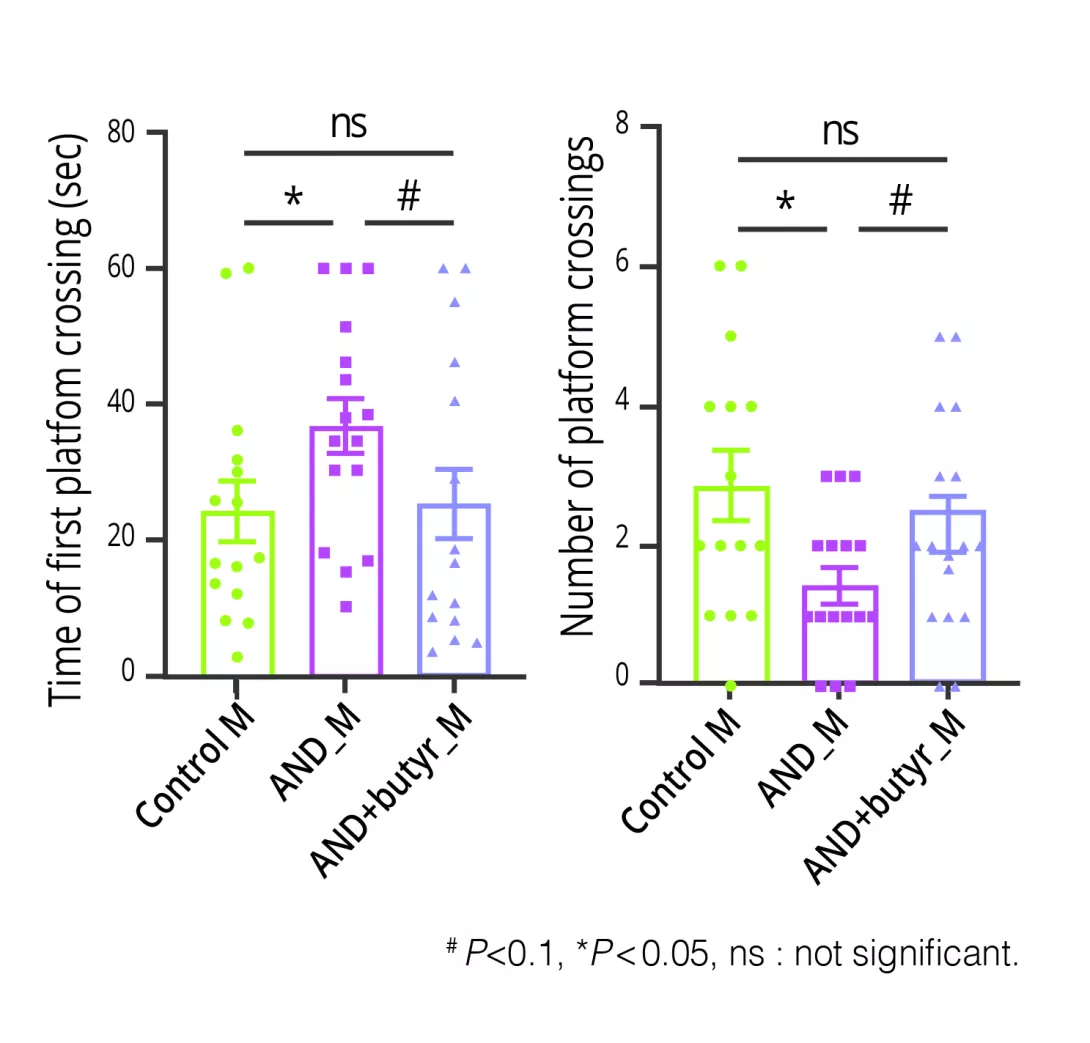
Figure 2 MAS

Measurement of tight junction protein expression (claudin-1, ZO-1, ZO-2) between colonocytes, reflecting gut permeability in germ-free mice having received faecal matter from control mothers (Control_M), AND mothers (AND_M) and AND mothers treated with butyrate during pregnancy (AND+butyr_M). Permeability was impaired in the AND_M group and improved with butyrate supplementation during pregnancy.

Image
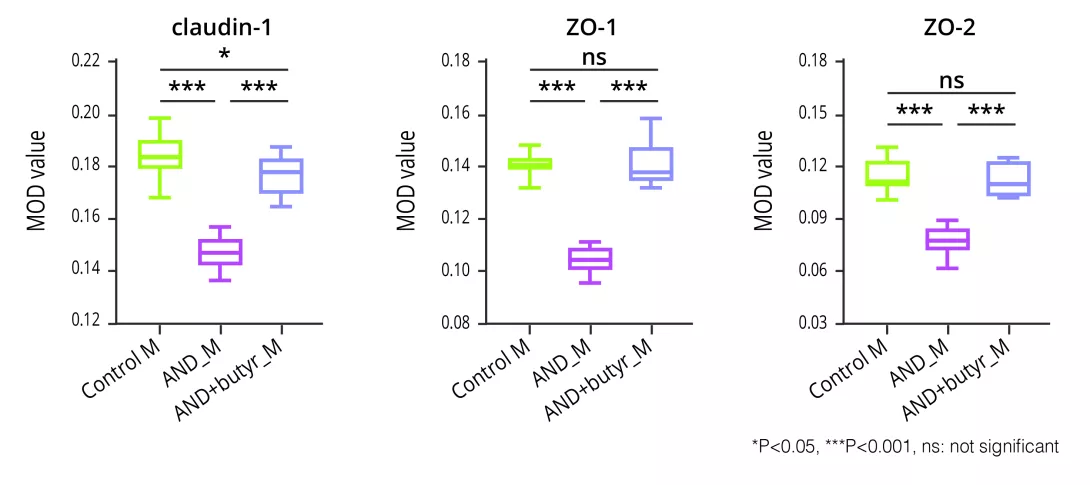
Figure 3 MAS

Conclusion

Antenatal depression impairs neurodevelopment in children, linked to changes in the maternal GM. Experiments conducted in mice showed that maternal gut dysbiosis increases intestinal permeability, which in turn is associated with foetal brain inflammation and lower activity of metabolic pathways (PUFAs and amino acids). Butyrate supplementation during pregnancy mitigated these effects.

Sources:

1.Zhou F, Wang L, Zhao Y, et al. Antenatal depressive symptoms impair offspring neurodevelopment by inducing maternal gut microbiota dysbiosis during pregnancy. Gut Microbes 2026; 18: 2672188.

Tags
Microbiome Flora
    Focus
    Microbiota 25 - October 2026
    • Overview
      • Functional dyspepsia and the gut microbiota
    • Commented article
      • Gut micro-organisms associated with health, nutrition and dietary interventions
      • Antenatal depressive symptoms impair offspring neurodevelopment by inducing maternal gut microbiota dysbiosis during pregnancy
    • Congress review
      • Highlights from the ESPGHAN 2026
    • Focus on Young researchers
      • Why do different people behave differently to probiotics?
    • Press review
      • Gut microbiota #25
      • Vaginal microbiota #25
    • Expert opinion
      • Millets as powerful prebiotics
    Created 09 November 2026
    Updated 09 November 2026

    About this article

    To know more about this topic.

    Content type

    Commented article
    Gut micro-organisms associated with health, nutrition and dietary interventions
    Highlights from the ESPGHAN 2026
    Focus

    Microbiota 25 - October 2026

    Overview

    Functional dyspepsia and the gut microbiota

    Commented article

    Gut micro-organisms associated with health, nutrition and dietary interventions Antenatal depressive symptoms impair offspring neurodevelopment by inducing maternal gut microbiota dysbiosis during pregnancy

    Congress review

    Highlights from the ESPGHAN 2026

    Focus on Young researchers

    Why do different people behave differently to probiotics?

    Press review

    Gut microbiota #25 Vaginal microbiota #25

    Expert opinion

    Millets as powerful prebiotics
    • Our publications
      • News
      • HCP Magazine
      • Thematic pages
      • Thematic folders
      • Overviews - Microbiota Magazine
    • About the Institute
      • About us
      • International Microbiota Observatory
      • Press room
      • Partnerships
    • Congresses
      • Congress calendar
      • Congress reviews
    • Continuing Medical Education
      • Accrediting courses
    • Useful documents
      • How to talk about
      • Infographics
      • Diagnosis tools
      • Patients Stories
      • Experts' point of view

    Lay public section

    Find here your dedicated section
    Gastroenterology
    Gynecology
    Pediatrics
    General Medicine
    • English

    Browse the site

    • Our publications
      • News
      • HCP Magazine
      • Thematic pages
      • Thematic folders
      • Overviews - Microbiota Magazine
    • About the Institute
      • About us
      • International Microbiota Observatory
      • Press room
      • Partnerships
    • Congresses
      • Congress calendar
      • Congress reviews
    • Continuing Medical Education
      • Accrediting courses
    • Useful documents
      • How to talk about
      • Infographics
      • Diagnosis tools
      • Patients Stories
      • Experts' point of view

    Lay public section

    Find here your dedicated section

    Discover

    Gastroenterology
    Gynecology
    Pediatrics
    General Medicine

    Join the microbiota community

    • Facebook
    • Twitter
    • LinkedIn
    • YouTube
    • Instagram
    • Bluesky

    Lay public section

    Find here your dedicated section

    Redirection

    You are about to be redirected and leave our website

    • Be redirected
    • Stay on the Biocodex Microbiota Institute's website

    Stay updated

    Join the Microbiota Community of HCPs and researchers and receive “Microbiota Digest” and "HCP Magazine" to stay up to date on the latest news about microbiota.

    * Mandatory Fields

    BMI 20-35

    Stay with us !

    Join the Microbiota Community of HCPs and researchers and receive “Microbiota Digest” and "HCP Magazine" to stay up to date on the latest news about microbiota.

    * Mandatory Fields

    BMI 20-35

    Explore

    Expert opinion 25
    09.11.2026

    Millets as powerful prebiotics

    Read the article
    Vaginal microbiota 25
    09.11.2026

    Vaginal microbiota #25

    Read the article
    Couv press review Mag 18
    09.11.2026

    Gut microbiota #25

    Read the article
    • Our publications
      • News
      • HCP Magazine
      • Thematic pages
      • Thematic folders
      • Overviews - Microbiota Magazine
    • About the Institute
      • About us
      • International Microbiota Observatory
      • Press room
      • Partnerships
    • Congresses
      • Congress calendar
      • Congress reviews
    • Continuing Medical Education
      • Accrediting courses
    • Useful documents
      • How to talk about
      • Infographics
      • Diagnosis tools
      • Patients Stories
      • Experts' point of view

    Lay public section

    Find here your dedicated section

    Discover

    Gastroenterology
    Gynecology
    Pediatrics
    General Medicine

    Lay public section

    Find here your dedicated section

    Join the microbiota community

    • Facebook
    • Twitter
    • LinkedIn
    • YouTube
    • Instagram
    • Bluesky

    © 2026 Biocodex. All rights reserved.

    • Legal notice
    • GTU
    • Data protection policy
    • Sitemap
    • Cookies settings
    • Digital accessibility : partially compliant
    Biocodex logo