

Towards a health-associated core keystone (key species) index for the human gut microbiota
COMMENTED ARTICLE - Adults’ section
By Pr. Harry Sokol
Gastroenterology and Nutrition Department, Saint-Antoine Hospital, Paris, France
Comments on the original article by Goel et al., Cell Reports 2025 1
Lay public section
Find here your dedicated section

About this article
Created
12 November 2025
Updated
14 October 2026
A robust index of gut microbiome taxa, encompassing their association with host health and microbiome resilience, would be valuable for the development and optimisation of microbiomebased therapeutics. In this article the authors present a single ranked order for 201 taxa, the Health-Associated Core Keystone (HACK) index, derived using their prevalence/community association in non-diseased subjects, their temporal stability and their association with host health. This index was constructed using 127 discovery cohorts and 14 validation datasets (a cumulative total of 45,424 gut microbiomes from subjects aged over 18 years, representing 42 countries, 28 disease categories and 10,021 longitudinal samples). The authors show that this index is reproducible regardless of microbiome profiling strategies and cohort lifestyle. Specific consortia of high HACK index taxa respond positively to Mediterranean diet-based interventions, are associated with better immune checkpoint inhibitor responsiveness and display specific functional profiles at the genome-level. The availability of HACK indices thus provides a rational basis for comparing microbiomes and facilitating the selection and design of microbiome-based therapies.
What do we already know about this subject?
Gut microbiome-based therapeutics (including probiotics, live biotherapeutic products, prebiotics/synbiotics and faecal transplantation) aim to restore a healthy microbiota, but with varying degrees of success depending on the population. To optimise these approaches, a consensual definition of a “healthy” microbiome would be needed - a challenging task due to the high degree of interindividual variability.
However, meta-analyses reveal taxa that are consistently depleted or enriched across multiple diseases, suggesting that microbes can be positioned along a spectrum of association with host health 2, 3. High-ranking species on this scale would have the greatest potential: i) as direct therapeutic agents or targets for enrichment;ii) as markers of clinical efficacy. The authors therefore propose creating a priority index integrating three criteria: positive association with health, contribution to microbiota stability and strong community “interaction”. This index, which can be applied to large public datasets, would serve as a rational tool for selecting and evaluating future microbial therapeutic strategies.
What are the main insights from this study?
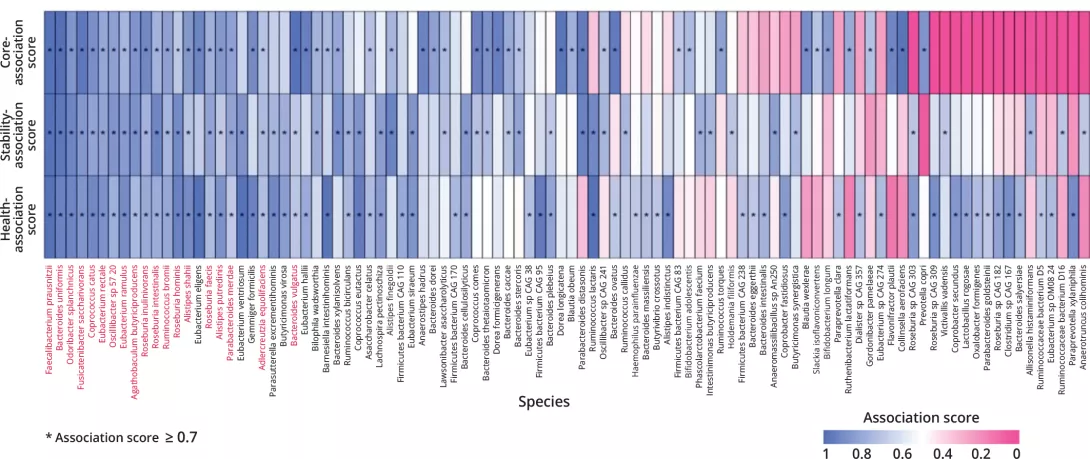
Using a discovery cohort comprising 39,926 gut microbiomes from 127 cohorts (including cross-sectional and longitudinal data, spanning 42 countries and 28 different diseases), the authors generated a ranking of 201 prevalent (core) gut microbiota taxa (those detected in ≥ 5% of samples in ≥ 50% of the studied cohorts), the HACK index (Health-Associated Core Keystone Index), each being assigned a score based on three quantifiable properties: i) prevalence/community association in non-diseased subjects; ii) temporal stability; and iii) negative association with disease.
The HACK index was calculated as the product of two scores: i) the mean of the association scores of a taxon for all the three properties; and ii) a reward score assessing the similarity (or how evenly distributed) these three scores were with respect to each other. Analysis of the highest- ranked taxa based on this order revealed 17 taxa having a HACK index of ≥ 75% (figure 1). These taxa all had individual scores of ≥ 70% for the three properties. These included Faecalibacterium prausnitzii, a well-recognised marker of microbiome health [4], followed by Bacteroides uniformis. The list also features several species from the genera Roseburia, Alistipes, and Eubacterium, as well as Coprococcus catus.
The authors then demonstrated the reproducibility of both the individual scores and the overall HACK index by recalculating the association scores within each cohort separately, using different sequencing methods (Shotgun or 16S) and across different type of populations (industrialised urban versus other), followed by an additional validation dataset composed of 14 additional cohorts totalling 5,498 microbiomes.
Beyond their stronger association with health and microbiota stability, some taxa with a high HACK index were also associated with favourable responses to various microbiota-related interventions, such as the Mediterranean diet or anti- cancer immunotherapy.
By analysing genome-level functional annotations from 32,005 genomes representing 122 of the 201 taxa, the authors identified 150 functional features (tags or fragments) specifically enriched and conserved in the genomes of taxa having high HACK indices. These represent a wide range of functions: production of butyrate/propionate with anti-inflammatory properties, synthesis of numerous vitamins, biosynthesis of neuroactive amino acids like tryptophan, and their beneficial anti-inflammatory derivatives such as indoles, or chondroitin sulphates. These are functionalities which warrant exploration to understand underlying mechanisms.
Image
What are the consequences in practice?
The HACK indices were calculated from a global cohort of 45,000 gut microbiomes spanning the six major continents, making this one of the most comprehensive studies to date. These indices represent a step forward in the rational prioritisation of gut microbial species as potential candidates for microbiome based therapeutics. In addition, functionalities associated with high HACK indices may help identify pathways and metabolic capabilities linked to the general health and stability of the microbiome.
Key points
- Based on 45,454 microbiomes from 141 cohorts (42 countries and 28 disease groups), this study ranked 201 taxa according to their association with three key traits of host and microbiome health: i) prevalence in non-diseased subjects;ii) temporal stability; and iii) negative association with disease
- Among the 17 bacteria with the highest scores, Faecalibacterium prausnitzii and Bacteroides uniformis ranked first and second, respectively
- The ranking was reproducible regardless of sequencing method or lifestyle of the cohorts
- The highest-ranked taxa are associated with positive responses to various microbiota- related therapeutic interventions
Conclusion
Drawing on a very large database, this study identifies a group of 17 taxa that are particularly prevalent (core taxa), stable over time and associated with health. In addition to progressing towards the definition of key components of the human microbiota in terms of both taxonomy and function, this work provides a rational basis for the development of novel therapies based on the gut microbiota or targeting it.
Sources:
- Goel A, Shete O, Goswami S, et al. Toward a health-associated core keystone index for the human gut microbiome. Cell Rep 2025 ; 44 : 115378.
- Shanahan F, Ghosh TS, O’Toole PW. The Healthy Microbiome—What Is the Definition of a Healthy Gut Microbiome? Gastroenterology 2021 ; 160 : 483-94.
- Pasolli E, Asnicar F, Manara S, et al. Extensive Unexplored Human Microbiome Diversity Revealed by Over 150,000 Genomes from Metagenomes Spanning Age, Geography, and Lifestyle. Cell 2019 ; 176 : 649-62.
- Martín R, Rios-Covian D, Huillet E, et al. Faecalibacterium: a bacterial genus with promising human health applications. FEMS Microbiol Rev 2023 ; 47.