
About the Institute
  • English

Breadcrumb

  1. Home
  2. Microbiota 23 - October 2025
  3. Interconnected pathways link plasma lipids, fecal microbiota and brain activity to cognition related to childhood malnutrition
  • Our publications
    • News
    • HCP Magazine
    • Thematic pages
    • Experts' point of view
    • Thematic folders
    • Overviews - Microbiota Magazine
  • About the Institute
    • About us
    • International Microbiota Observatory
    • Press room
    • Partnerships
  • Congresses
    • Congress calendar
    • Congress reviews
  • Continuing Medical Education
    • Accrediting courses
  • Useful documents
    • How to talk about
    • Infographics
    • Diagnosis tools
    • Patients Stories

    Join the microbiota community

    • Facebook
    • Twitter
    • LinkedIn
    • YouTube
    • Instagram
    • Bluesky

Lay public section

Find here your dedicated section


Gastroenterology
Gynecology
Pediatrics
General Medicine

Breadcrumb

  1. Home
  2. Microbiota 23 - October 2025
  3. Interconnected pathways link plasma lipids, fecal microbiota and brain activity to cognition related to childhood malnutrition

Interconnected pathways link plasma lipids, fecal microbiota and brain activity to cognition related to childhood malnutrition

COMMENTED ARTICLE - Children's section

By Prof. Emmanuel Mas
Gastroenterology and Nutrition Department, Children's Hospital, Toulouse, France

Comments on the original article by Portlock et al., Nat Commun 1

Gastroenterology
Gynecology
Pediatrics
General Medicine
  • Our publications
    • News
    • HCP Magazine
    • Thematic pages
    • Experts' point of view
    • Thematic folders
    • Overviews - Microbiota Magazine
  • About the Institute
    • About us
    • International Microbiota Observatory
    • Press room
    • Partnerships
  • Congresses
    • Congress calendar
    • Congress reviews
  • Continuing Medical Education
    • Accrediting courses
  • Useful documents
    • How to talk about
    • Infographics
    • Diagnosis tools
    • Patients Stories

    Join the microbiota community

    • Facebook
    • Twitter
    • LinkedIn
    • YouTube
    • Instagram
    • Bluesky

Lay public section

Find here your dedicated section

Sources

This article is based on scientific information

Sharing is caring

Your colleagues might be interested in this topic. Why not share it?

  • Facebook
  • Twitter
  • LinkedIn
  • Mail

Sections

About this article

Created 12 November 2025
Updated 15 December 2025

Malnutrition affects more than 30 million children every year and has profound immediate and long-lasting repercussions. Children who survive often suffer long-lasting neurocognitive sequelae that impact on their school performance and socio-economic status. The mechanisms behind these consequences are poorly understood. Using SHAP models interpreted by multisystem random forest and network analysis, the authors show that moderate acute malnutrition (MAM) is associated with increased stool Rothia mucilaginosa and Streptococcus salivarius and decreased Bacteroides fragilis in a group of one-year-old children in Dhaka, Bangladesh. These changes in the microbiome form interconnected pathways involving reduced plasma levels of oddchain fatty acids, decreased electroencephalogram gamma and beta power in temporal and frontal brain regions, and reduced vocalization. These results support the hypothesis that prolonged colonization with oral commensal species delays the development of the gut and brain microbiome. Although causal links need to be validated by empirical data, this study provides useful information to improve interventions targeting neurodevelopmental deficits associated with MAM.

What do we already know about this subject

Childhood malnutrition is a major public health problem and one of the leading causes of death before the age of five. Moderate acute malnutrition (MAM) is associated with delayed neurocognitive development, but the link remains poorly understood. It is also associated with dysbiosis of the gut microbiota (GM), whose establishment is slowed and marked by enrichment in Bifidobacterium and Escherichia species. These disturbances in the gut microbiota could have an impact on cerebral development via the gut-brain axis, due to defective nutrient absorption or accumulation of toxic metabolites. This inter-organ communication could be mediated indirectly by plasma lipids, as lipids are the essential constituent of the brain and are modulated by MI metabolites  such as bile acids.

What are the main insights from this study?

The study was carried out in the Mirpur region of Bangladesh, and compared 159 children with MAM with 75 well-nourished controls at 12 months of age. MAM was defined by a weight/height ratio between -2 and -3 z-scores. The MAM group was significantly associated with social-demographic factors (toilet, mode of delivery and water treatment - kettle).

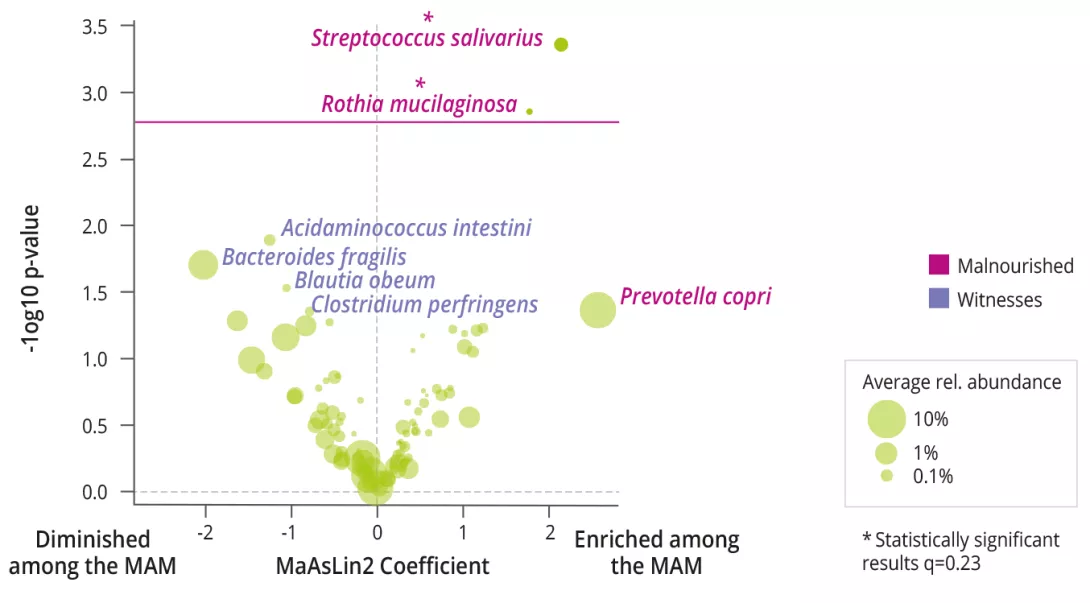
MAM was associated with decreased bacterial alpha diversity (Shannon), increased prevalence and abundance of Rothia mucilaginosa and Streptococcus salivarius (figure 1), and an increased Bacteroidetes/Firmicutes ratio. Functional analyses of the MI showed no differences.

Image
The electroencephalogram (EEG) showed a significant decrease in beta (12-30 Hz) and gamma (30-45 Hz) frequencies in the temporal and frontal regions of children with MAM. Significant decreases in expressive communication, fine and gross motor scores, and vocalization were also observed.

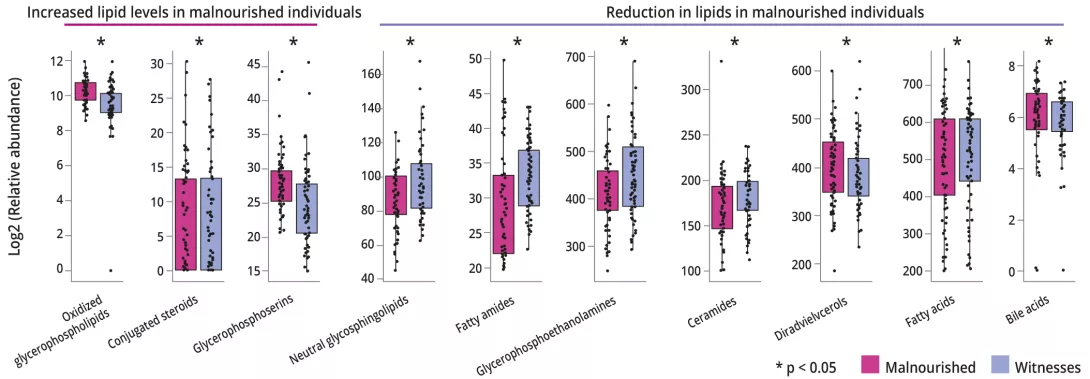
After adjusting for mode of delivery, gender and duration of exclusive breastfeeding, MAM was associated with changes in plasma lipidome, with relative abundance increased by 128 (16%) compounds and decreased by 189 (24%) (figure 2).

Image
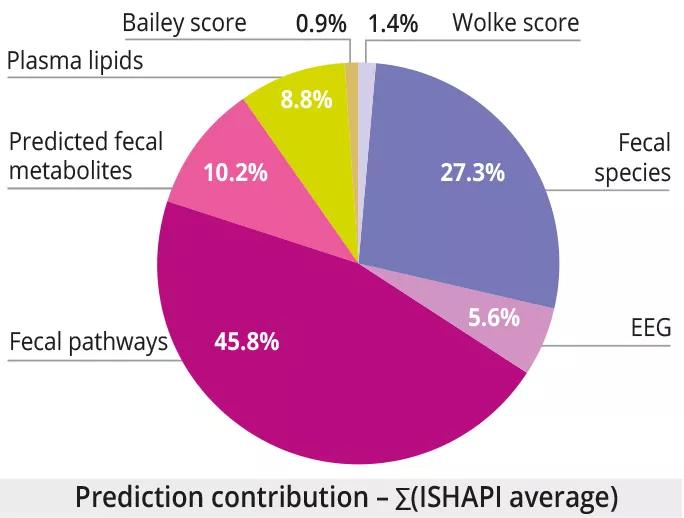
Integration of multimodal data showed that the best predictors of MAM at 12 months were: 1) plasma lipids (AUROC = 0.95 0.05); 2) brain and behavioral measures (Wolke score, EEG, Bayley score) (AUROC = 0.73±0.05, 0.71±0.10, 0.68±0.07 respectively) ; 3) the taxonomic, functional and predicted metabolite profile of the fecal microbiome (AUROC = 0.56±0.07, 0.53±0.07, 0.52±0.06). Note the high proportion of data related to the fecal microbiome for predicting MAM in multimodal analysis, despite the poor performance of the fecal microbiome (figure 3).

Multimodal network analysis predicted that a cluster of B. fragilis, pyruvate fermentation pathways, plasma ceramides, EEG and expressive communication was strongly correlated with good nutritional status at 12 months. Finally, the strongest effect as an interspecies interaction was observed between R. mucilaginosa and S.salivarius, whose combined presence amplified the prediction of MAM at 12 months.

Image
What are the consequences in practice?

This study shows the importance of GM in the nutritional status of infants. The presence of commensal gram-positive and facultative anaerobic oral bacteria such as R. mucilaginosa and S. salivarius may be responsible for deregulation of bile acids. This could lead to lipid changes that are important for brain development.

In addition, it is important to highlight the benefit of B. fragilis in relation to fermentation pathways on nutritional status at 12 months.

Key point
  • Intestinal persistence of commensal bacteria Rothia mucilaginosa and Streptococcus salivarius in MAM children overrides colonization by Bacteroides fragilis. This interferes with the synthesis of
    fatty acids essential for brain development

Conclusion

This study highlights that dysbiosis of the gut microbiota is associated with abnormalities in brain development present in children with MAM, via changes in plasma lipids.

Sources
  1. Portlock T, Shama T, Kakon SH, et al. Interconnected pathways link faecal microbiota plasma lipids and brain activity to childhood malnutrition related cognition. Nat Commun 2025 ; 16 : 473.
Tags
Microbiome Flora
    Focus
    Microbiota 23 - October 2025
    • Overview
      • When drugs meet microbes: a bidirectional dialogue with therapeutic implications
    • Commented article
      • Towards a health-associated core keystone (key species) index for the human gut microbiota
      • Interconnected pathways link plasma lipids, fecal microbiota and brain activity to cognition related to childhood malnutrition
    • Focus on young researchers
      • Can we target microbiota in the management of children with functional abdominal pain disorders?
    • Congress review
      • ESPGHAN 2025: Focus on microbiota-drug interactions
    • Press review
      • Gut microbiota #23
      • Vaginal microbiota #23
    • Expert opinion
      • Live probiotic coconut yogurt, is it worth recommending?
    Created 12 November 2025
    Updated 15 December 2025

    About this article

    To know more about this topic.

    Content type

    Commented article
    Towards a health-associated core keystone (key species) index for the human gut microbiota
    Can we target microbiota in the management of children with functional abdominal pain disorders?
    Focus

    Microbiota 23 - October 2025

    Overview

    When drugs meet microbes: a bidirectional dialogue with therapeutic implications

    Commented article

    Towards a health-associated core keystone (key species) index for the human gut microbiota Interconnected pathways link plasma lipids, fecal microbiota and brain activity to cognition related to childhood malnutrition

    Focus on young researchers

    Can we target microbiota in the management of children with functional abdominal pain disorders?

    Congress review

    ESPGHAN 2025: Focus on microbiota-drug interactions

    Press review

    Gut microbiota #23 Vaginal microbiota #23

    Expert opinion

    Live probiotic coconut yogurt, is it worth recommending?
    • Our publications
      • News
      • HCP Magazine
      • Thematic pages
      • Experts' point of view
      • Thematic folders
      • Overviews - Microbiota Magazine
    • About the Institute
      • About us
      • International Microbiota Observatory
      • Press room
      • Partnerships
    • Congresses
      • Congress calendar
      • Congress reviews
    • Continuing Medical Education
      • Accrediting courses
    • Useful documents
      • How to talk about
      • Infographics
      • Diagnosis tools
      • Patients Stories

      Join the microbiota community

      • Facebook
      • Twitter
      • LinkedIn
      • YouTube
      • Instagram
      • Bluesky

    Lay public section

    Find here your dedicated section
    Gastroenterology
    Gynecology
    Pediatrics
    General Medicine
    • English

    Browse the site

    • Our publications
      • News
      • HCP Magazine
      • Thematic pages
      • Experts' point of view
      • Thematic folders
      • Overviews - Microbiota Magazine
    • About the Institute
      • About us
      • International Microbiota Observatory
      • Press room
      • Partnerships
    • Congresses
      • Congress calendar
      • Congress reviews
    • Continuing Medical Education
      • Accrediting courses
    • Useful documents
      • How to talk about
      • Infographics
      • Diagnosis tools
      • Patients Stories

      Join the microbiota community

      • Facebook
      • Twitter
      • LinkedIn
      • YouTube
      • Instagram
      • Bluesky

    Lay public section

    Find here your dedicated section

    Discover

    Gastroenterology
    Gynecology
    Pediatrics
    General Medicine

    Join the microbiota community

    • Facebook
    • Twitter
    • LinkedIn
    • YouTube
    • Instagram
    • Bluesky

    Lay public section

    Find here your dedicated section

    Redirection

    You are about to be redirected and leave our website

    • Be redirected
    • Stay on the Biocodex Microbiota Institute's website

    Stay with us !

    Join the Microbiota Community of HCPs and researchers and receive “Microbiota Digest” and "HCP Magazine" to stay up to date on the latest news about microbiota.

    * Mandatory Fields

    BMI 20-35

    Explore

    04.12.2025

    This one gut microbe could change the way cancer therapy performs

    Read the article
    26.11.2025

    Anti-inflammatory diet and cognitive impairment: role of the oral and gut microbiota

    Read the article
    20.11.2025

    Gut–mind–pelvic axis: new insights from microbiome science

    Read the article

    Stay updated

    Join the Microbiota Community of HCPs and researchers and receive “Microbiota Digest” and "HCP Magazine" to stay up to date on the latest news about microbiota.

    * Mandatory Fields

    BMI 20-35

    • Our publications
      • News
      • HCP Magazine
      • Thematic pages
      • Experts' point of view
      • Thematic folders
      • Overviews - Microbiota Magazine
    • About the Institute
      • About us
      • International Microbiota Observatory
      • Press room
      • Partnerships
    • Congresses
      • Congress calendar
      • Congress reviews
    • Continuing Medical Education
      • Accrediting courses
    • Useful documents
      • How to talk about
      • Infographics
      • Diagnosis tools
      • Patients Stories

      Join the microbiota community

      • Facebook
      • Twitter
      • LinkedIn
      • YouTube
      • Instagram
      • Bluesky

    Lay public section

    Find here your dedicated section

    Discover

    Gastroenterology
    Gynecology
    Pediatrics
    General Medicine

    Lay public section

    Find here your dedicated section

    Join the microbiota community

    • Facebook
    • Twitter
    • LinkedIn
    • YouTube
    • Instagram
    • Bluesky

    © 2025 Biocodex. All rights reserved.

    • Legal notice
    • GTU
    • Data protection policy
    • Sitemap
    • Cookies settings
    • Digital accessibility : partially compliant
    Biocodex logo