

About the Institute
  • English
  • Français
  • Español
  • Portuguese
  • Polish
  • Ukrainian

Breadcrumb

  1. Home
  2. The power of your gut
  3. Gut microbiota: the link between diet and endometriosis!
  • Learn all about microbiota
    • The gut microbiota
    • The ENT microbiota
    • The pulmonary microbiota
    • The urinary microbiota
    • The skin microbiota
    • The vaginal microbiota
    • The exposome
  • Microbiota and related conditions
    • Digestive disorders
    • Women disorders
    • Metabolic disorders
    • Skin disorders
    • Pediatric disorders
    • Psychiatric disorders
    • Neurological disorders
    • Respiratory disorders
    • Urinary disorders
  • Act on your microbiota
    • Probiotics
    • Prebiotics
    • Diet
  • Publications
    • News
    • Thematic folders
    • Thematic pages
    • Microbiota Q & A
    • Patients stories
    • Experts' point of view
  • About the Institute
    • About us
    • International Microbiota Observatory
    • Microbiotalks
    • Press room
    • Partnerships

Healthcare professionals section

Find here your dedicated section
Biocodex logo
The power of your gut
Our marvelous microbiota
My microbiota as a woman

Breadcrumb

  1. Home
  2. The power of your gut
  3. Gut microbiota: the link between diet and endometriosis!
The power of your gut

Gut microbiota: the link between diet and endometriosis!

Endometriosis
The gut microbiota The vaginal microbiota Women disorders What foods promote a balanced microbiota?

Does a high-fat/low-fiber diet aggravate endometriosis? A recent study in mice suggests so, also indicating a protective role for gut bacterium A. muciniphila. 1

The power of your gut
Our marvelous microbiota
My microbiota as a woman
  • Learn all about microbiota
    • The gut microbiota
    • The ENT microbiota
    • The pulmonary microbiota
    • The urinary microbiota
    • The skin microbiota
    • The vaginal microbiota
    • The exposome
  • Microbiota and related conditions
    • Digestive disorders
    • Women disorders
    • Metabolic disorders
    • Skin disorders
    • Pediatric disorders
    • Psychiatric disorders
    • Neurological disorders
    • Respiratory disorders
    • Urinary disorders
  • Act on your microbiota
    • Probiotics
    • Prebiotics
    • Diet
  • Publications
    • News
    • Thematic folders
    • Thematic pages
    • Microbiota Q & A
    • Patients stories
    • Experts' point of view
  • About the Institute
    • About us
    • International Microbiota Observatory
    • Microbiotalks
    • Press room
    • Partnerships

Healthcare professionals section

Find here your dedicated section
Biocodex logo

Sources

This article is based on scientific information

Sharing is caring

Your friends might be interested in this topic. Why not share it?

  • Facebook
  • Twitter
  • Mail

About this article

Created 28 February 2025
Updated 01 July 2026

Endometriosis is a disease where tissue similar to the lining of the uterus – which is eliminated during menstruation – begins to colonize places where it does not belong (ovaries, peritoneum, etc.). This results in pain, complicated periods, digestive problems, and sometimes even infertility. Endometriosis affects around 10% of women of childbearing age.

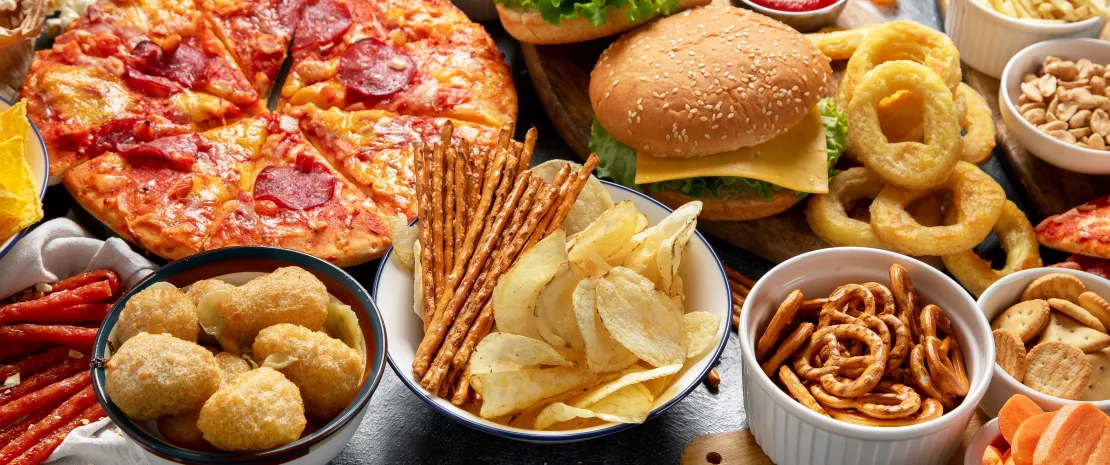
We already know that diet can play a role in inflammation: a balanced diet appears to help reduce pain. But a team of researchers wanted to see what the opposite would do, i.e. a typically Western diet, high in fat and low in fiber. To this end, they used mice as… guinea pigs.

10% Endometriosis affects roughly 10% (190 million) of reproductive age women and girls globally. ²

Western diet results in lesions twice as large

The mice were fed either a “normal” rodent diet (17% fat) or a fast-food diet (45% fat, low in fiber) for four weeks. Endometriosis was then surgically induced and changes in the lesions were monitored over seven weeks. The result? The mice on a Western diet developed lesions twice as large as the control mice. Not only were the lesions larger, but they were also more fibrous and full of cells in maximum proliferation mode.

03.10.2023 A bacterium to blame for endometriosis? Read more

Metabolism and immunity: when everything goes too far

What causes this? The fast-food diet appears to disrupt metabolism and immunity:

  • it boosts the activity of macrophages (immune cells which here seem more harmful than beneficial)
  • it activates leptin, a hormone involved in the growth of lesions and glucose metabolism
  • it accelerates the oxidation of glucose, which acts as fuel for the lesions

But what about the microbiota?

The study also showed that endometriosis alters the gut flora of mice, regardless of their diet. But in mice on a Western diet, one particular bacterium, Akkermansia muciniphila, known for its anti-inflammatory effects, partially disappears when endometriosis is induced. The disease may thus create an imbalance in the gut microbiota by ousting protective bacteria.

What now?

Since the study was conducted on mice, rather than humans, the results remain preliminary. However, it has confirmed that diet has a major impact on endometriosis and that a healthier diet may limit pain and the progression of the disease. The gut microbiota also plays a key role in the pathophysiology of endometriosis, while certain bacteria such as Akkermansia muciniphila may have a protective effect.

This discovery paves the way for new therapeutic approaches based on modulation of the microbiota. Without saying goodbye forever to French fries, what about adding a few vegetables to your meal to give your good bacteria a helping hand.

Endometriosis and microbiota: is there a link?

Learn more
Sources

1. Parpex G, Chassaing B, Bourdon M et al. Western diet promotes endometriotic lesion growth in mice and induces depletion of Akkermansia muciniphila in intestinal microbiota. BMC Med. 2024 Nov 6;22(1):513.

2. https://www.who.int/news-room/fact-sheets/detail/endometriosis

Tags
Microbiome Flora Endometriosis Women health Gut microbiota Vaginal microbiota Western diet Diet

    See also

    When bacteria signal the presence of endometriosis
    Periods and endometriosis: what is the role of the microbiota? Periods and endometriosis: what is the role of the microbiota?
    Created 28 February 2025
    Updated 01 July 2026

    About this article

    To know more about this topic.

    Main topic

    Endometriosis

    Related microbiotas

    The gut microbiota

    Related topics

    The vaginal microbiota Women disorders What foods promote a balanced microbiota?
    The power of your gut

    The gut microbiota

    Gut microbiota: why is it that important for your health? We have trillions1 of bacteria that populate...

    Find out more

    What foods promote a balanced microbiota?

    We don’t always realize that the food we eat provides essential nourishment not only to our body, but to th...

    Find out more

    Chronic abdominal pain in children: could it be IBS?

    “Mom, dad, my tummy hurts…”. Just an excuse to skip school, or a real illness? If the abdominal pain is rec...

    Find out more

    Irritable bowel syndrome (IBS)

    Irritable bowel syndrome (IBS), previously called a “functional bowel disorder”, is the most common gut-bra...

    Find out more

    Chronic inflammatory bowel diseases and FMT

    Although Clostridium difficile colitis is the only approved indication for the use of fecal microbiota tran...

    Find out more

    Microbiotalk: "Break barriers and address taboos in women’s health" - 2025

    Breaking Barriers: A Bold Conversation on Women’s Health ...

    Find out more

    Microbiotalk: short conferences on antimicrobial resistance

    Breaking the silence: a global conversation on antimicrobial resistance Antimicrobial resistance (AMR) is ...

    Find out more

    Antibiotic-associated diarrhea

    Antibiotics are a powerful tool in the fight against bacterial infections. While treatments sometimes appea...

    Find out more

    Latest news

    News
    26.02.2024

    Sleep apnea: bacteria of the gut microbiota implicated

    Read the article
    05.03.2024

    A probiotic for binge eating?

    Read the article
    23.04.2024

    Viral diarrhea: when a devious virus invites itself into our intestines

    Read the article
    23.04.2024

    Parasitic diarrhea: microbiota, a key prognostic element?

    Read the article
    23.04.2024

    Bacterial diarrhea: the only case where antibiotics can be used

    Read the article
    23.04.2024

    Behind the scenes of infectious diarrhea: the role of microbiota

    Read the article
    28.05.2024

    Functional dyspepsia: a complicated name for a common digestive disorder

    Read the article
    03.07.2024

    Disrupted paternal microbiota: unhealthy young

    Read the article
    • Learn all about microbiota
      • The gut microbiota
      • The ENT microbiota
      • The pulmonary microbiota
      • The urinary microbiota
      • The skin microbiota
      • The vaginal microbiota
      • The exposome
    • Microbiota and related conditions
      • Digestive disorders
      • Women disorders
      • Metabolic disorders
      • Skin disorders
      • Pediatric disorders
      • Psychiatric disorders
      • Neurological disorders
      • Respiratory disorders
      • Urinary disorders
    • Act on your microbiota
      • Probiotics
      • Prebiotics
      • Diet
    • Publications
      • News
      • Thematic folders
      • Thematic pages
      • Microbiota Q & A
      • Patients stories
      • Experts' point of view
    • About the Institute
      • About us
      • International Microbiota Observatory
      • Microbiotalks
      • Press room
      • Partnerships

    Healthcare professionals section

    Find here your dedicated section
    Biocodex logo
    The power of your gut
    Our marvelous microbiota
    My microbiota as a woman
    • English
    • Français
    • Español
    • Portuguese
    • Polish
    • Ukrainian

    Browse the site

    • Learn all about microbiota
      • The gut microbiota
      • The ENT microbiota
      • The pulmonary microbiota
      • The urinary microbiota
      • The skin microbiota
      • The vaginal microbiota
      • The exposome
    • Microbiota and related conditions
      • Digestive disorders
      • Women disorders
      • Metabolic disorders
      • Skin disorders
      • Pediatric disorders
      • Psychiatric disorders
      • Neurological disorders
      • Respiratory disorders
      • Urinary disorders
    • Act on your microbiota
      • Probiotics
      • Prebiotics
      • Diet
    • Publications
      • News
      • Thematic folders
      • Thematic pages
      • Microbiota Q & A
      • Patients stories
      • Experts' point of view
    • About the Institute
      • About us
      • International Microbiota Observatory
      • Microbiotalks
      • Press room
      • Partnerships

    Healthcare professionals section

    Find here your dedicated section
    Biocodex logo

    Discover

    The power of your gut
    Our marvelous microbiota
    My microbiota as a woman

    Join the microbiota community

    • Facebook
    • Twitter
    • LinkedIn
    • YouTube
    • Instagram
    • Bluesky

    Healthcare professionals section

    Find here your dedicated section

    Redirection

    You are about to be redirected and leave our website

    • Be redirected
    • Stay on the Biocodex Microbiota Institute's website

    Stay updated

    Join the Microbiota Community and receive once a month “The Essential” to stay up to date on the latest news about microbiota.

    * Mandatory Fields

    BMI 20-35

    Stay with us !

    Join the microbiota community and receive "The Essentials" once a month to stay up to date with the latest news on the microbiota.

    * Mandatory Fields

    BMI 20-35

    Explore

    30.06.2026

    Kidney stones: a mix of minerals... and bacteria?

    Read the article
    23.06.2026

    Kefir: is it good for gut health?

    Read the article
    15.06.2026

    Protein-rich or high-fiber: which breakfast is best for our gut microbiota?

    Read the article
    • Learn all about microbiota
      • The gut microbiota
      • The ENT microbiota
      • The pulmonary microbiota
      • The urinary microbiota
      • The skin microbiota
      • The vaginal microbiota
      • The exposome
    • Microbiota and related conditions
      • Digestive disorders
      • Women disorders
      • Metabolic disorders
      • Skin disorders
      • Pediatric disorders
      • Psychiatric disorders
      • Neurological disorders
      • Respiratory disorders
      • Urinary disorders
    • Act on your microbiota
      • Probiotics
      • Prebiotics
      • Diet
    • Publications
      • News
      • Thematic folders
      • Thematic pages
      • Microbiota Q & A
      • Patients stories
      • Experts' point of view
    • About the Institute
      • About us
      • International Microbiota Observatory
      • Microbiotalks
      • Press room
      • Partnerships

    Healthcare professionals section

    Find here your dedicated section
    Biocodex logo

    Discover

    The power of your gut
    Our marvelous microbiota
    My microbiota as a woman

    Healthcare professionals section

    Find here your dedicated section

    Join the microbiota community

    • Facebook
    • Twitter
    • LinkedIn
    • YouTube
    • Instagram
    • Bluesky

    © 2026 Biocodex. All rights reserved.

    • Legal notice
    • GTU
    • Data protection policy
    • Sitemap
    • Cookies settings
    • Digital accessibility : partially compliant
    Biocodex logo