

About the Institute
  • English
  • Français
  • Español
  • Portuguese
  • Polish

Breadcrumb

  1. Home
  2. The power of your gut
  3. Colorectal cancer: could bacteria within tumors predict disease progression?
  • Learn all about microbiota
    • The gut microbiota
    • The ENT microbiota
    • The pulmonary microbiota
    • The urinary microbiota
    • The skin microbiota
    • The vaginal microbiota
    • The exposome
  • Microbiota and related conditions
    • Digestive disorders
    • Women disorders
    • Metabolic disorders
    • Skin disorders
    • Pediatric disorders
    • Psychiatric disorders
    • Neurological disorders
    • Respiratory disorders
    • Urinary disorders
  • Act on your microbiota
    • Probiotics
    • Prebiotics
    • Diet
  • Publications
    • News
    • Thematic folders
    • Thematic pages
    • Microbiota Q & A
    • Patients stories
    • Experts' point of view
  • About the Institute
    • About us
    • International Microbiota Observatory
    • Microbiotalks
    • Press room
    • Partnerships

Healthcare professionals section

Find here your dedicated section
Biocodex logo
The power of your gut
Our marvelous microbiota
My microbiota as a woman

Breadcrumb

  1. Home
  2. The power of your gut
  3. Colorectal cancer: could bacteria within tumors predict disease progression?
The power of your gut

Colorectal cancer: could bacteria within tumors predict disease progression?

Cancer
The gut microbiota

Bacteria found directly within colorectal tumors may help predict how the disease will progress. This is the conclusion of a large international study published in late 2025, focused on a cancer that affects nearly 48,000 people in France each year.

The power of your gut
Our marvelous microbiota
My microbiota as a woman
  • Learn all about microbiota
    • The gut microbiota
    • The ENT microbiota
    • The pulmonary microbiota
    • The urinary microbiota
    • The skin microbiota
    • The vaginal microbiota
    • The exposome
  • Microbiota and related conditions
    • Digestive disorders
    • Women disorders
    • Metabolic disorders
    • Skin disorders
    • Pediatric disorders
    • Psychiatric disorders
    • Neurological disorders
    • Respiratory disorders
    • Urinary disorders
  • Act on your microbiota
    • Probiotics
    • Prebiotics
    • Diet
  • Publications
    • News
    • Thematic folders
    • Thematic pages
    • Microbiota Q & A
    • Patients stories
    • Experts' point of view
  • About the Institute
    • About us
    • International Microbiota Observatory
    • Microbiotalks
    • Press room
    • Partnerships

Healthcare professionals section

Find here your dedicated section
Biocodex logo

Sources

This article is based on scientific information

Sharing is caring

Your friends might be interested in this topic. Why not share it?

  • Facebook
  • Twitter
  • Mail
Colorectal cancer: could bacteria within tumors predict  disease progression?

About this article

Created 15 July 2026
Updated 16 July 2026

A common cancer among people over 50

Colorectal cancer affects the colon or rectum and is the second leading cause of cancer-related death worldwide, according to the WHO 1.

47 582 In France, 47,582 new cases were diagnosed in 2023 – 95% of which occurred in people over the age of 50, with men accounting for 55% of cases and women 45% ².

This disease results from an abnormal transformation of colorectal cells that multiply uncontrollably.
Known risk factors include:

  • age,
  • family history,
  • and certain inflammatory bowel diseases.

But researchers have begun to investigate another potential factor: bacteria present directly within tumor tissues. 

Subtypes of colorectal cancer

Colorectal cancer is not a homogeneous group. Scientists have established a classification into four molecular subtypes (CMS1 through CMS4), based on:

  • biological characteristics,
  • behavior,
  • and response to treatments 4.

This classification helps physicians better tailor treatment to each patient. 

CMS1
  • Highly mutated tumors
  • with strong immune response,
  • typically located in the right side of the colon.

In the study, CMS1 tumors showed an enrichment of several Fusobacterium subspecies and bacteria of oral origin compared to the other subtypes.

CMS2

The most common subtype.
In this subtype, the presence of the
pks genetic module and the abundance of Enterobacteriaceae are associated with a poorer prognosis.

CMS3

Tumors with specific metabolic abnormalities.

CMS4

A subtype associated with a poorer overall prognosis and a higher risk of metastases. In the study, the presence of specific Fusobacterium subspecies was associated with worse clinical outcomes for this subtype.

Bacteria at the heart of the tumor

It has long been established that the human gut is home to billions of microorganisms – the gut microbiota – which play a key role in immune system and overall health.

Gut microbiota: our immune system’s best friend

Learn more

A study 3 published in Nature Communications in December 2025, involving 937 Swedish patients, found that bacteria are also present directly within tumor tissues, alongside colorectal cancer cells. 

03.08.2021 Stomach Cancer Read more

Using an advanced sequencing technique, researchers identified 361 bacterial species in the tumors and adjacent tissues, including:

  • several genera from the Enterobacteriaceae family (notably E. coli),
  • several genera within the Firmicutes phylum,
  • as well as the genera Fusobacterium, Akkermansia and Treponema.

The findings suggest that specific microbial profiles are associated with poorer clinical outcomes: for example, pks+ strains of E. coli were found in 17.4% of the tumors analyzed. These bacteria carry a genetic module –pks – which enables the production of colibactin, a toxin which directly attacks the DNA of colon cells.

The colon: a key organ

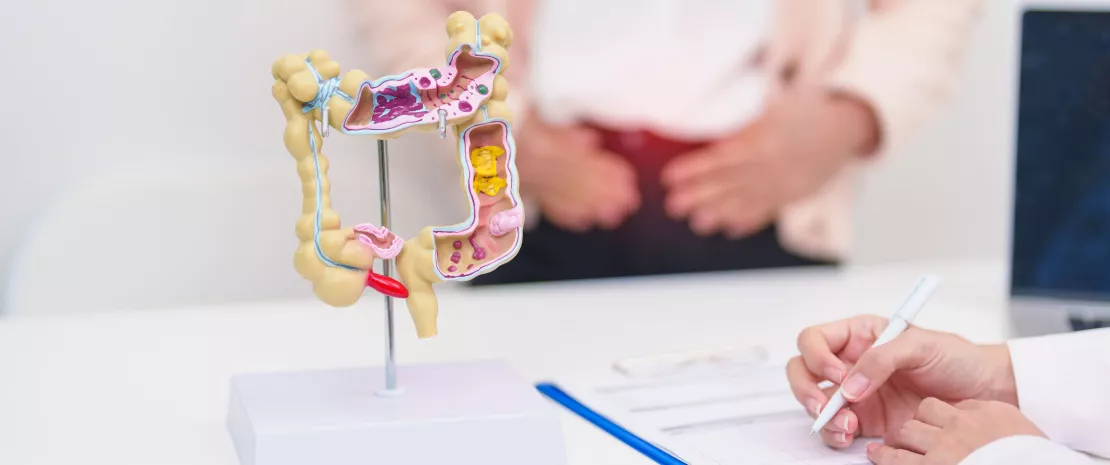
The colon is the final section of the intestine. It is approximately 5 feet long and is divided into several sections:

  • the ascending colon,
  • the descending colon,
  • and the rectum. 

Colorectal cancer develops in the lining of the colon or rectum where the gut microbiota – composed of billions of bacteria that play a vital role in human health – also resides. 

The researchers also observed that some bacteria present inside tumors appear to interact with the local immune system by activating inflammatory pathways, a mechanism known to promote tumor progression.
These associations were consistently observed across multiple patient cohorts, which reinforces the reliability of the findings.

Promising results

Based on these observations, the researchers developed a risk score based on the bacterial composition of colorectal tumors.
This score can help predict how the disease is likely to progress in a patient, complementing existing diagnostic tools – regardless of
 :

  • age,
  • cancer stage,
  • or the tumor’s genetic characteristics.

Ultimately, the bacterial profile of colorectal tumors could become a valuable tool to aid in prognosis and patient monitoring, and pave the way for new therapeutic strategies targeting the immune system and microbiota.
However, these results remain correlational and further studies are needed to confirm the underlying mechanisms. 

Sources

1. PAHO-Bilan mondial du cancer.
2. Ameli-Cancer colorectal.
3. Shi Z. et al. Tissue-resident microbiota impacts colorectal cancer progression and prognosis. Nature Communications, 2026, 17:346. https://doi.org/10.1038/s41467-025-67047-2.
4. Guinney J. et al. The consensus molecular subtypes of colorectal cancer. Nature Medicine, 2015, 21(11), 1350–1356. https://doi.org/10.1038/nm.3967.

Tags
Oncology Colorectal cancer Cancer Immunity Immune response CRC Biomarker Immunotherapy Microbiome Flora

    See also

    Immunotherapy even more effective thanks to gut microbiota of seniors
    Created 15 July 2026
    Updated 16 July 2026

    About this article

    To know more about this topic.

    Main topic

    Cancer

    Related microbiotas

    The gut microbiota
    The power of your gut

    The many health benefits of fermented foods

    Bread, yogurt, cheese, vegetables, cured meats... fermented foods play a major role in our diets and culina...

    Find out more

    The gut microbiota

    Gut microbiota: why is it that important for your health? We have trillions1 of bacteria that populate...

    Find out more

    What foods promote a balanced microbiota?

    We don’t always realize that the food we eat provides essential nourishment not only to our body, but to th...

    Find out more

    Chronic abdominal pain in children: could it be IBS?

    “Mom, dad, my tummy hurts…”. Just an excuse to skip school, or a real illness? If the abdominal pain is rec...

    Find out more

    Irritable bowel syndrome (IBS)

    Irritable bowel syndrome (IBS), previously called a “functional bowel disorder”, is the most common gut-bra...

    Find out more

    Chronic inflammatory bowel diseases and FMT

    Although Clostridium difficile colitis is the only approved indication for the use of fecal microbiota tran...

    Find out more

    Microbiotalk: "Break barriers and address taboos in women’s health" - 2025

    Breaking Barriers: A Bold Conversation on Women’s Health ...

    Find out more

    Microbiotalk: short conferences on antimicrobial resistance

    Breaking the silence: a global conversation on antimicrobial resistance Antimicrobial resistance (AMR) is ...

    Find out more

    Latest news

    News
    28.02.2023

    Why running could bring a smile to depressed teens... and their gut microbiota

    Read the article
    Photo: Avec le « binge drinking », le microbiote intestinal des jeunes trinque
    23.03.2023

    Binge drinking leaves gut microbiota of young people with a hangover

    Read the article
    Photo: Quand la migraine prend aux tripes
    29.03.2023

    Migraine: a gut feeling?

    Read the article
    Photo: Fatigue chronique : une seule bactérie vous manque, et tout votre corps est épuisé
    25.04.2023

    A single bacterium is missing for you, and your whole body is tired

    Read the article
    Photo: Une « super bactérie » pour combattre les effets de la dénutrition ?
    26.04.2023

    A “super bacterium” that combats the effects of malnutrition?

    Read the article
    Obésité et microbiote : une bactérie aggrave l’effet d’une alimentation riche en graisses
    15.05.2023

    Obesity and microbiota: A bacterium worsens the effect of a high-fat diet

    Read the article
    Photo: Addicted to prunes? Your microbiota and your health will thank you!
    19.05.2023

    Addicted to prunes? Your microbiota and your health will thank you!

    Read the article
    Photo: Social phobia is all in the head... and in the microbiota
    26.05.2023

    Social phobia is all in the head... and in the microbiota

    Read the article
    • Learn all about microbiota
      • The gut microbiota
      • The ENT microbiota
      • The pulmonary microbiota
      • The urinary microbiota
      • The skin microbiota
      • The vaginal microbiota
      • The exposome
    • Microbiota and related conditions
      • Digestive disorders
      • Women disorders
      • Metabolic disorders
      • Skin disorders
      • Pediatric disorders
      • Psychiatric disorders
      • Neurological disorders
      • Respiratory disorders
      • Urinary disorders
    • Act on your microbiota
      • Probiotics
      • Prebiotics
      • Diet
    • Publications
      • News
      • Thematic folders
      • Thematic pages
      • Microbiota Q & A
      • Patients stories
      • Experts' point of view
    • About the Institute
      • About us
      • International Microbiota Observatory
      • Microbiotalks
      • Press room
      • Partnerships

    Healthcare professionals section

    Find here your dedicated section
    Biocodex logo
    The power of your gut
    Our marvelous microbiota
    My microbiota as a woman
    • English
    • Français
    • Español
    • Portuguese
    • Polish

    Browse the site

    • Learn all about microbiota
      • The gut microbiota
      • The ENT microbiota
      • The pulmonary microbiota
      • The urinary microbiota
      • The skin microbiota
      • The vaginal microbiota
      • The exposome
    • Microbiota and related conditions
      • Digestive disorders
      • Women disorders
      • Metabolic disorders
      • Skin disorders
      • Pediatric disorders
      • Psychiatric disorders
      • Neurological disorders
      • Respiratory disorders
      • Urinary disorders
    • Act on your microbiota
      • Probiotics
      • Prebiotics
      • Diet
    • Publications
      • News
      • Thematic folders
      • Thematic pages
      • Microbiota Q & A
      • Patients stories
      • Experts' point of view
    • About the Institute
      • About us
      • International Microbiota Observatory
      • Microbiotalks
      • Press room
      • Partnerships

    Healthcare professionals section

    Find here your dedicated section
    Biocodex logo

    Discover

    The power of your gut
    Our marvelous microbiota
    My microbiota as a woman

    Join the microbiota community

    • Facebook
    • Twitter
    • LinkedIn
    • YouTube
    • Instagram
    • Bluesky

    Healthcare professionals section

    Find here your dedicated section

    Redirection

    You are about to be redirected and leave our website

    • Be redirected
    • Stay on the Biocodex Microbiota Institute's website

    Stay updated

    Join the Microbiota Community and receive once a month “The Essential” to stay up to date on the latest news about microbiota.

    * Mandatory Fields

    BMI 20-35

    Stay with us !

    Join the microbiota community and receive "The Essentials" once a month to stay up to date with the latest news on the microbiota.

    * Mandatory Fields

    BMI 20-35

    Explore

    Colorectal cancer: could bacteria within tumors predict  disease progression?
    15.07.2026

    Colorectal cancer: could bacteria within tumors predict disease progression?

    Read the article

    The many health benefits of fermented foods

    Bread, yogurt, cheese, vegetables, cured meats... fermented foods play a major role in our diets and culina...

    Find out more
    Could One Gut Bacterium replace a Gym Membership?
    06.07.2026

    Could one gut bacterium replace a gym membership?

    Read the article
    • Learn all about microbiota
      • The gut microbiota
      • The ENT microbiota
      • The pulmonary microbiota
      • The urinary microbiota
      • The skin microbiota
      • The vaginal microbiota
      • The exposome
    • Microbiota and related conditions
      • Digestive disorders
      • Women disorders
      • Metabolic disorders
      • Skin disorders
      • Pediatric disorders
      • Psychiatric disorders
      • Neurological disorders
      • Respiratory disorders
      • Urinary disorders
    • Act on your microbiota
      • Probiotics
      • Prebiotics
      • Diet
    • Publications
      • News
      • Thematic folders
      • Thematic pages
      • Microbiota Q & A
      • Patients stories
      • Experts' point of view
    • About the Institute
      • About us
      • International Microbiota Observatory
      • Microbiotalks
      • Press room
      • Partnerships

    Healthcare professionals section

    Find here your dedicated section
    Biocodex logo

    Discover

    The power of your gut
    Our marvelous microbiota
    My microbiota as a woman

    Healthcare professionals section

    Find here your dedicated section

    Join the microbiota community

    • Facebook
    • Twitter
    • LinkedIn
    • YouTube
    • Instagram
    • Bluesky

    © 2026 Biocodex. All rights reserved.

    • Legal notice
    • GTU
    • Data protection policy
    • Sitemap
    • Cookies settings
    • Digital accessibility : partially compliant
    Biocodex logo