

About the Institute
  • English
  • Español
  • Portuguese
  • Polish

Breadcrumb

  1. Home
  2. Our marvelous microbiota
  3. Oral microbiome dynamics during travel : environmental exposure, dysbiosis, and resilience
  • Learn all about microbiota
    • The gut microbiota
    • The ENT microbiota
    • The pulmonary microbiota
    • The urinary microbiota
    • The skin microbiota
    • The vaginal microbiota
    • The exposome
  • Microbiota and related conditions
    • Digestive disorders
    • Women disorders
    • Metabolic disorders
    • Skin disorders
    • Pediatric disorders
    • Psychiatric disorders
    • Neurological disorders
    • Respiratory disorders
    • Urinary disorders
  • Act on your microbiota
    • Probiotics
    • Prebiotics
    • Diet
  • Publications
    • News
    • Thematic folders
    • Thematic pages
    • Microbiota Q & A
    • Patients stories
    • Experts' point of view
  • About the Institute
    • About us
    • International Microbiota Observatory
    • Microbiotalks
    • Press room
    • Partnerships

Healthcare professionals section

Find here your dedicated section
Biocodex logo
The power of your gut
Our marvelous microbiota
My microbiota as a woman

Breadcrumb

  1. Home
  2. Our marvelous microbiota
  3. Oral microbiome dynamics during travel : environmental exposure, dysbiosis, and resilience
Our marvelous microbiota

Oral microbiome dynamics during travel : environmental exposure, dysbiosis, and resilience

Exposome
The ENT microbiota
The power of your gut
Our marvelous microbiota
My microbiota as a woman
  • Learn all about microbiota
    • The gut microbiota
    • The ENT microbiota
    • The pulmonary microbiota
    • The urinary microbiota
    • The skin microbiota
    • The vaginal microbiota
    • The exposome
  • Microbiota and related conditions
    • Digestive disorders
    • Women disorders
    • Metabolic disorders
    • Skin disorders
    • Pediatric disorders
    • Psychiatric disorders
    • Neurological disorders
    • Respiratory disorders
    • Urinary disorders
  • Act on your microbiota
    • Probiotics
    • Prebiotics
    • Diet
  • Publications
    • News
    • Thematic folders
    • Thematic pages
    • Microbiota Q & A
    • Patients stories
    • Experts' point of view
  • About the Institute
    • About us
    • International Microbiota Observatory
    • Microbiotalks
    • Press room
    • Partnerships

Healthcare professionals section

Find here your dedicated section
Biocodex logo

Sources

This article is based on scientific information
Sharing is caring

Your friends might be interested in this topic. Why not share it?

  • Facebook
  • Twitter
  • Mail
Evolución de la microbiota bucal durante los viajes: exposición ambiental, disbiosis y resiliencia

About this article

Created 21 September 2026
Updated 24 September 2026

 1. How much do people travel each year ?

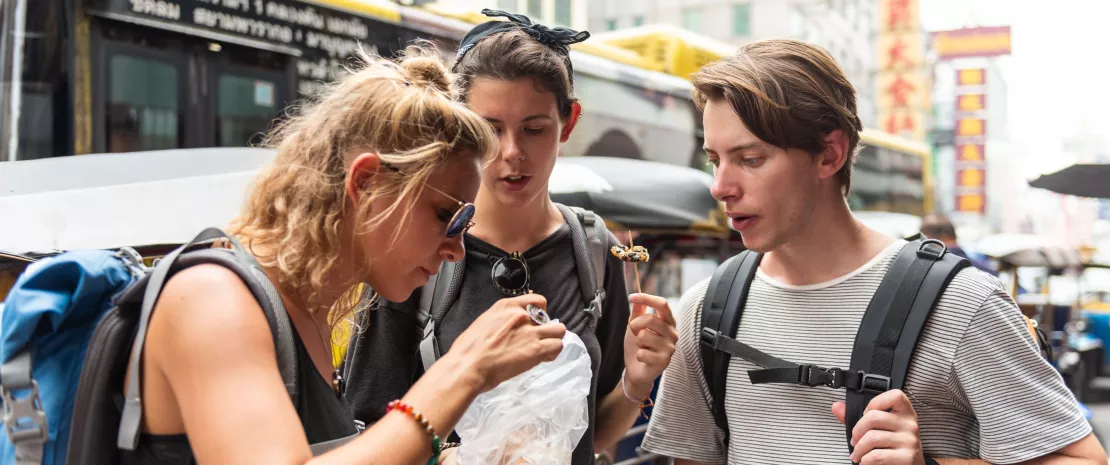
According to the European Commission, EU residents aged 15 years and older made nearly 1.2 billion tourism trips with overnight stays in 2024, corresponding to approximately three trips per person per year.1 This frequency of travel is biologically significant, as repeated movement between environments creates repeated opportunities for microbial exposure and short-term ecological disruption. While travel-associated changes in the gut microbiome and the clinical syndrome of travelers’ diarrhea are well documented, the oral microbiome—including saliva-, tongue-, and plaque-associated communities—has received far less attention, despite serving as a primary interface between the host and the external environment. 

Travel repeatedly perturbs the microbiome through exposure to new environments, diets, and water sources, yet the oral microbiome remains far less studied than the gut despite being the first point of contact.

2. Why travel should reshape the oral microbiome

The oral cavity is continuously exposed to the external environment, making it particularly sensitive to rapid lifestyle and environmental changes. Although oral microbial communities are generally stable within individuals, they respond to shifts in diet, oral hygiene practices, circadian rhythms, stress, and immune status. Oral health depends on community balance (homeostasis), and dysbiosis—disruption of community structure or function—is associated with both oral and systemic disease.2
Travel concentrates multiple perturbations simultaneously, including exposure to new environments, water sources, dietary patterns, and social contacts,3-4 all of which can influence resident microbial communities. As the entry point to the gastrointestinal tract, the oral cavity may also influence downstream microbial ecology. Large, multi-country studies have shown that oral microbes can transmit to and colonize the gut more frequently than previously appreciated, even in healthy individuals.5

Travel-induced microbiome disruption is often transient but not always fully reversible, with microbial and resistance-related changes persisting beyond clinical symptom resolution.

3. When travel introduces new microbes: dysbiosis, food poisoning, and diarrhea

A well-recognized risk of travel is acute gastrointestinal infection, often caused by food- or water-borne pathogens, which can coincide with microbial community disruption. Longitudinal studies show that microbiome composition shifts during travel and that diarrheal episodes can destabilize community structure and increase antimicrobial resistance gene abundance for weeks.6-7 Travel is also associated with colonization by multidrug-resistant organisms, particularly among individuals who experience travelers’ diarrhea.6 Clinically, most uncomplicated cases of travelers’ diarrhea resolve within days. However, microbiome studies suggest only partial resilience: microbial composition often trends back toward baseline after return, but recovery may be delayed or incomplete. Notably, travel-associated antimicrobial resistance signatures can persist for weeks following the initial disruption in some cohorts.6, 8-9

Traveling shapes our lives...but also our microbiota and antibiotic resistance

Learn More

4. The underexplored questions: acclimation time, stability, and permanence

Despite growing interest in travel-related microbiome dynamics, direct longitudinal sampling of the oral microbiome during travel remains rare. Time-series studies of the gut microbiome in non-travel settings reveal substantial day-to-day variability even under stable conditions, highlighting the need for dense longitudinal sampling to distinguish normal temporal variation from true travel-induced effects.4

Leveraging a year-long international gap-year program, Dr. Wendy Lin is tracking oral microbiome changes in a student cohort as they travel across seven regions, including the United States, Brazil, France, Turkey, Kenya, India, and China. This study aims to address fundamental questions that remain poorly characterized for the oral microbiome:

  • How long does it take for the oral microbiome to acclimate to a new environment?

  • Is the travel-associated oral microbiome stable or highly dynamic?

  • How quickly does the oral microbiome revert to baseline after returning home?

  • Do newly introduced taxa or strain-level variants persist long-term?

The timing, stability, and long-term persistence of travel-associated changes in the oral microbiome remain largely unknown.

Conclusion

Travel predictably alters environmental exposures and dietary patterns, creating a natural experiment for studying human microbiome ecology. Evidence from gut microbiome studies of travelers demonstrates rapid compositional shifts during travel and additional disruption during diarrheal illness, often followed by delayed or incomplete recovery. The oral microbiome—despite being the first point of contact for food, water, and environmental microbes—remains comparatively undercharacterized in this context. Longitudinal studies of traveling cohorts with dense oral sampling have the potential to answer foundational questions about microbial acclimation, stability, and long-term persistence, and to determine whether travel leaves lasting microbial imprints after individuals return home. 

Sources

1.https://ec.europa.eu/eurostat/statistics-explained/index.php?title=Tourism_trips_-_introduction_and_key_figures

2. https://pmc.ncbi.nlm.nih.gov/articles/PMC5960472

3. https://www.gutmicrobiotaforhealth.com/wp-content/uploads/2016/06/The-Human-Microbiome-Diet-and-Health-Workshop-Summary.pdf

4. https://www.nature.com/articles/s41467-021-27098-7

5. https://elifesciences.org/articles/42693

6. https://www.nature.com/articles/s41467-022-34862-w

7. https://pmc.ncbi.nlm.nih.gov/articles/PMC4615231

8. https://journals.asm.org/doi/10.1128/mbio.02790-23

9. https://www.sciencedirect.com/science/article/pii/S1477893925000754

Tags
Microbiome Flora

    See also

    Tasting the difference: how our oral microbiota influences flavor perception
    What are your mouth microbes really telling you!
    Created 21 September 2026
    Updated 24 September 2026

    About this article

    To know more about this topic.

    Main topic

    Exposome

    Related microbiotas

    The ENT microbiota
    Our marvelous microbiota

    What foods promote a balanced microbiota?

    We don’t always realize that the food we eat provides essential nourishment not only to our body, but to th...

    Find out more

    Natural remedies against osteoporosis?

    Menopause is characterized by estrogen deficiency, which reduces bone mineral density (BMD) and changes the...

    Find out more

    Everything you need to know about sleep and microbiota

    We all know how a bad night's sleep can ruin the next day, but what if your gut had something to do with it...

    Find out more

    The gut microbiota

    Gut microbiota: why is it that important for your health? We have trillions1 of bacteria that populate...

    Find out more

    Chronic abdominal pain in children: could it be IBS?

    “Mom, dad, my tummy hurts…”. Just an excuse to skip school, or a real illness? If the abdominal pain is rec...

    Find out more

    Acne and microbiota

    Acne, which is a very common skin disease during adolescence, is caused by hormonal changes associated with...

    Find out more

    Microbiotalk: "Break barriers and address taboos in women’s health" - 2025

    Breaking Barriers: A Bold Conversation on Women’s Health ...

    Find out more

    Exposome: exposed microbiota puts health at risk

    Have you ever noticed that some people seem to get sick more often than others? Behind this inequality lies...

    Find out more

    Latest news

    News
    16.10.2025

    The nasal microbiota: your baby’s first line of defense

    Read the article
     Peanut allergy: microbiota makes a difference
    27.08.2026

    Peanut allergy: microbiota makes a difference

    Read the article
    30.06.2026

    Kidney stones: a mix of minerals... and bacteria?

    Read the article
    11.06.2026

    Sunlight is reshaping the bacteria on your skin

    Read the article
    Photo: Dermatite atopique : il faut sauver la peau du champignon Malassezia
    12.10.2022

    Atopic dermatitis: protecting the skin from the Malassezia fungus

    Read the article
     Microbiote urétral : des infections urinaires masculines mieux comprises
    06.01.2023

    Urethral microbiota: a better understanding of male urinary tract infections

    Read the article
    Photo: « Rhume des foins » : la preuve d’une dysbiose nasale pointe le bout de son nez
    12.06.2023

    Hay fever: has a nasal dysbiosis been under our nose the whole time?

    Read the article
    13.02.2024

    The oral microbiome: very destabilized by smoking...but resilient

    Read the article
    • Learn all about microbiota
      • The gut microbiota
      • The ENT microbiota
      • The pulmonary microbiota
      • The urinary microbiota
      • The skin microbiota
      • The vaginal microbiota
      • The exposome
    • Microbiota and related conditions
      • Digestive disorders
      • Women disorders
      • Metabolic disorders
      • Skin disorders
      • Pediatric disorders
      • Psychiatric disorders
      • Neurological disorders
      • Respiratory disorders
      • Urinary disorders
    • Act on your microbiota
      • Probiotics
      • Prebiotics
      • Diet
    • Publications
      • News
      • Thematic folders
      • Thematic pages
      • Microbiota Q & A
      • Patients stories
      • Experts' point of view
    • About the Institute
      • About us
      • International Microbiota Observatory
      • Microbiotalks
      • Press room
      • Partnerships

    Healthcare professionals section

    Find here your dedicated section
    Biocodex logo
    The power of your gut
    Our marvelous microbiota
    My microbiota as a woman
    • English
    • Español
    • Portuguese
    • Polish

    Browse the site

    • Learn all about microbiota
      • The gut microbiota
      • The ENT microbiota
      • The pulmonary microbiota
      • The urinary microbiota
      • The skin microbiota
      • The vaginal microbiota
      • The exposome
    • Microbiota and related conditions
      • Digestive disorders
      • Women disorders
      • Metabolic disorders
      • Skin disorders
      • Pediatric disorders
      • Psychiatric disorders
      • Neurological disorders
      • Respiratory disorders
      • Urinary disorders
    • Act on your microbiota
      • Probiotics
      • Prebiotics
      • Diet
    • Publications
      • News
      • Thematic folders
      • Thematic pages
      • Microbiota Q & A
      • Patients stories
      • Experts' point of view
    • About the Institute
      • About us
      • International Microbiota Observatory
      • Microbiotalks
      • Press room
      • Partnerships

    Healthcare professionals section

    Find here your dedicated section
    Biocodex logo

    Discover

    The power of your gut
    Our marvelous microbiota
    My microbiota as a woman

    Join the microbiota community

    • Facebook
    • Twitter
    • LinkedIn
    • YouTube
    • Instagram
    • Bluesky

    Healthcare professionals section

    Find here your dedicated section

    Redirection

    You are about to be redirected and leave our website

    • Be redirected
    • Stay on the Biocodex Microbiota Institute's website

    Stay updated

    Join the Microbiota Community and receive once a month “The Essential” to stay up to date on the latest news about microbiota.

    * Mandatory Fields

    BMI 20-35

    Stay with us !

    Join the microbiota community and receive "The Essentials" once a month to stay up to date with the latest news on the microbiota.

    * Mandatory Fields

    BMI 20-35

    Explore

    Oral Microbiome Dynamics During Travel: Environmental Exposure, Dysbiosis, and Resilience
    21.09.2026

    Oral microbiome dynamics during travel : environmental exposure, dysbiosis, and resilience

    Read the article
    15.09.2026

    Coffee and decaf: what effects do they have on the microbiota?

    Read the article
    Coupe menstruelle : un atout pour la santé vaginale ?
    08.09.2026

    Menstrual cup: a potential benefit for vaginal health ?

    Read the article
    • Learn all about microbiota
      • The gut microbiota
      • The ENT microbiota
      • The pulmonary microbiota
      • The urinary microbiota
      • The skin microbiota
      • The vaginal microbiota
      • The exposome
    • Microbiota and related conditions
      • Digestive disorders
      • Women disorders
      • Metabolic disorders
      • Skin disorders
      • Pediatric disorders
      • Psychiatric disorders
      • Neurological disorders
      • Respiratory disorders
      • Urinary disorders
    • Act on your microbiota
      • Probiotics
      • Prebiotics
      • Diet
    • Publications
      • News
      • Thematic folders
      • Thematic pages
      • Microbiota Q & A
      • Patients stories
      • Experts' point of view
    • About the Institute
      • About us
      • International Microbiota Observatory
      • Microbiotalks
      • Press room
      • Partnerships

    Healthcare professionals section

    Find here your dedicated section
    Biocodex logo

    Discover

    The power of your gut
    Our marvelous microbiota
    My microbiota as a woman

    Healthcare professionals section

    Find here your dedicated section

    Join the microbiota community

    • Facebook
    • Twitter
    • LinkedIn
    • YouTube
    • Instagram
    • Bluesky

    © 2026 Biocodex. All rights reserved.

    • Legal notice
    • GTU
    • Data protection policy
    • Sitemap
    • Cookies settings
    • Digital accessibility : partially compliant
    Biocodex logo